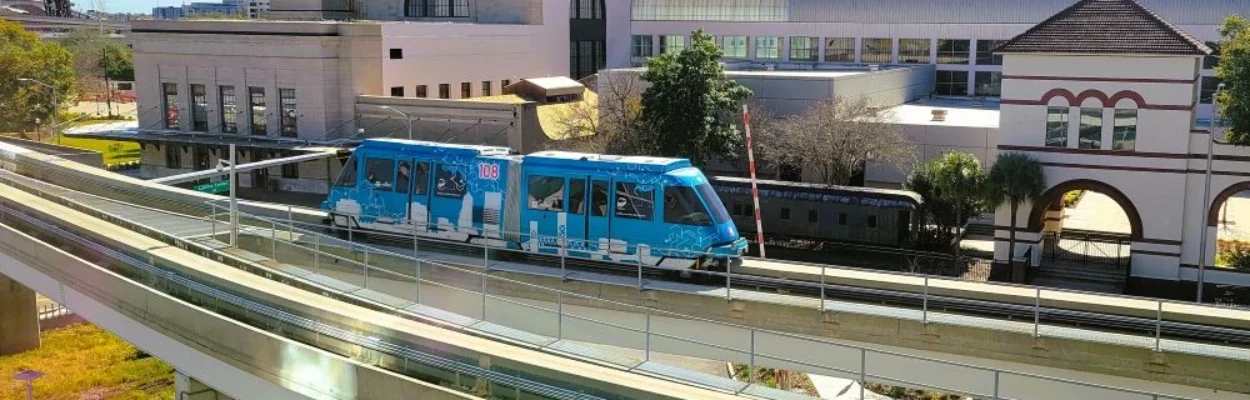
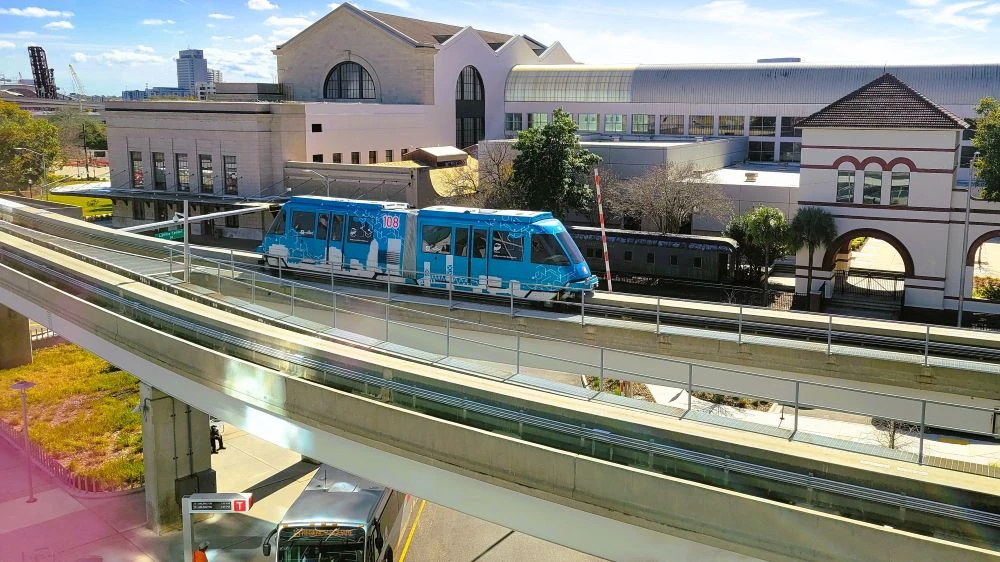
Skyway cars move into the LaVilla station of the Jacksonville Transportation Authority. The Skyway could be replaced by the Ultimate Urban Commuter system. | Dan Scanlan, Jacksonville Today
Published on February 23, 2026 at 12:39 pm
Free local news and info, in your inbox at 6 a.m. M-F. Sign up for the Jacksonville Today newsletter.
The Jacksonville Transportation Authority wants to hear from residents and business owners about the next phases of its autonomous vehicle shuttle system.
The second phase of the Ultimate Urban Circulator, known as U2C, would replace the current autonomous vans humming through Downtown. Those operate under the NAVI name — for Neighborhood Autonomous Vehicle Innovation.
Jacksonville Today thanks our sponsors. Become one.
JTA will have a series of town halls in coming weeks to present information and listen to comments about the next phrase of U2C. The first meetings are scheduled Wednesday:
- 11 a.m. at the JTA’s Regional Transportation Center, 100 LaVilla Center Drive
- 5 p.m. at the Jacksonville Marriott Downtown on Water Street
More meetings are set for March 5, 24 and 26. They will be the first in a series of gatherings this year, JTA officials said.
“These meetings are an important opportunity for residents, businesses and stakeholders to be part of the Skyway’s future,” Greer Johnson Gillis, JTA’s chief infrastructure and development officer, said in a news release. “Community feedback will play a key role as we evaluate options to enhance connectivity, improve system reliability and address evolving mobility needs in Downtown Jacksonville.”

Jacksonville Today thanks our sponsors. Become one.
The NAVI shuttles
NAVI is the transit authority’s first step in the bigger Ultimate Urban Circulator plan, which ultimately would replace the Skyway and link the Northbank to San Marco, Brooklyn and Riverside at an estimated cost of $400 million.
NAVI uses 14 autonomous electric Ford E-Transit vans on city streets between LaVilla and EverBank Stadium. An attendant sits in the driver’s seat for now to monitor progress, answer questions and take over driving when necessary.
JTA plans to keep the attendant on board for the first year of the service as a control center on West Bay Street monitors the EV vans.
Each van uses cameras, lasers, sonar and radar guidance systems to navigate around cars and pedestrians, and react to stoplights and crosswalks.
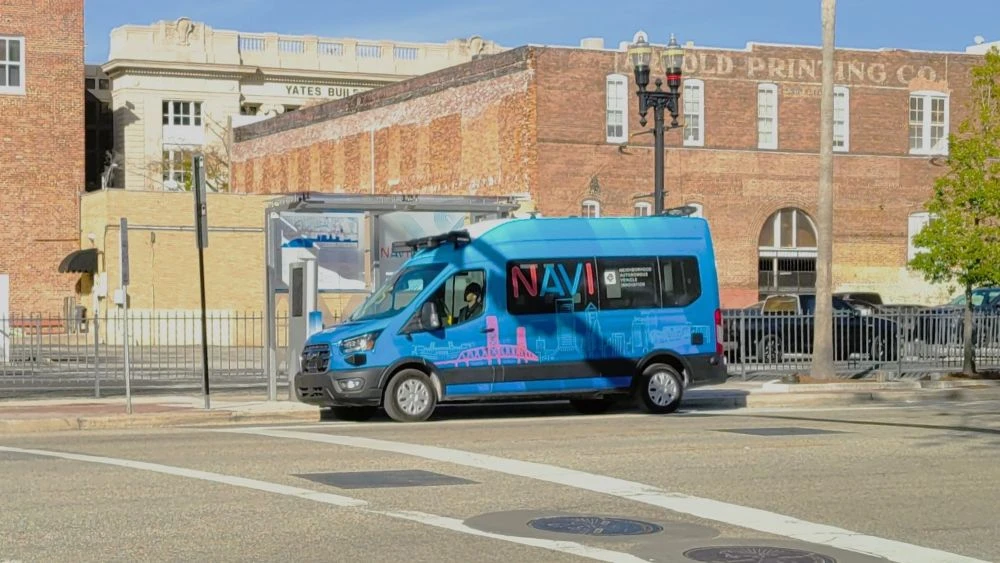
The current NAVI shuttles cost $65 million. Fifteen-passenger Holon Urban electric vehicles will replace the Ford vans sometime in 2027.
The Holon vehicles will be produced at the company’s first autonomous vehicle factory in Florida — on Zoo Parkway on Jacksonville’s Northside. Groundbreaking is expected soon on the new plant.
U2C Phase II
The U2C’s second phase would convert the existing 2.5-mile Skyway system in Downtown and San Marco into an elevated roadway for use by the Holons.
New ramps would allow them to travel from Bay Street to the overhead roadways, expanding U2C to four more Skyway stations on the Downtown Northbank and three more across the St. Johns River into the Southbank.
A stop also would be at the bus hub at the Jacksonville Regional Transportation Center at LaVilla.
The public meetings will discuss the Skyway rehabilitation planning and design study. More meetings planned for this May will focus on analysis of alternatives discussed at the current round of meetings, along with project recommendations.
Extension of the local option gas tax will partly fund the estimated $300 million cost, JTA officials say. No construction date has been set.
The U2C’s third phase would put the U2C on streets in the Brooklyn and Riverside areas, with an estimated cost of $100 million.
More information is available at jtafla.com.