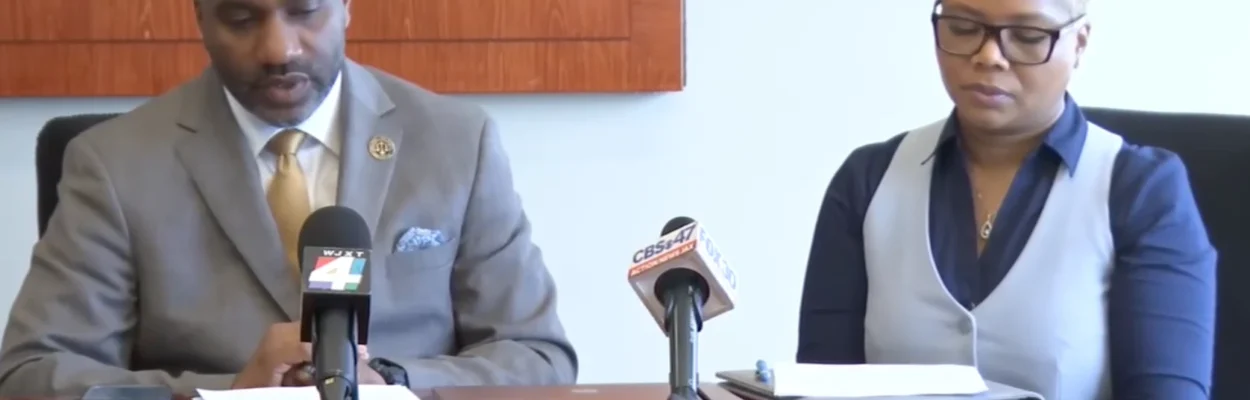
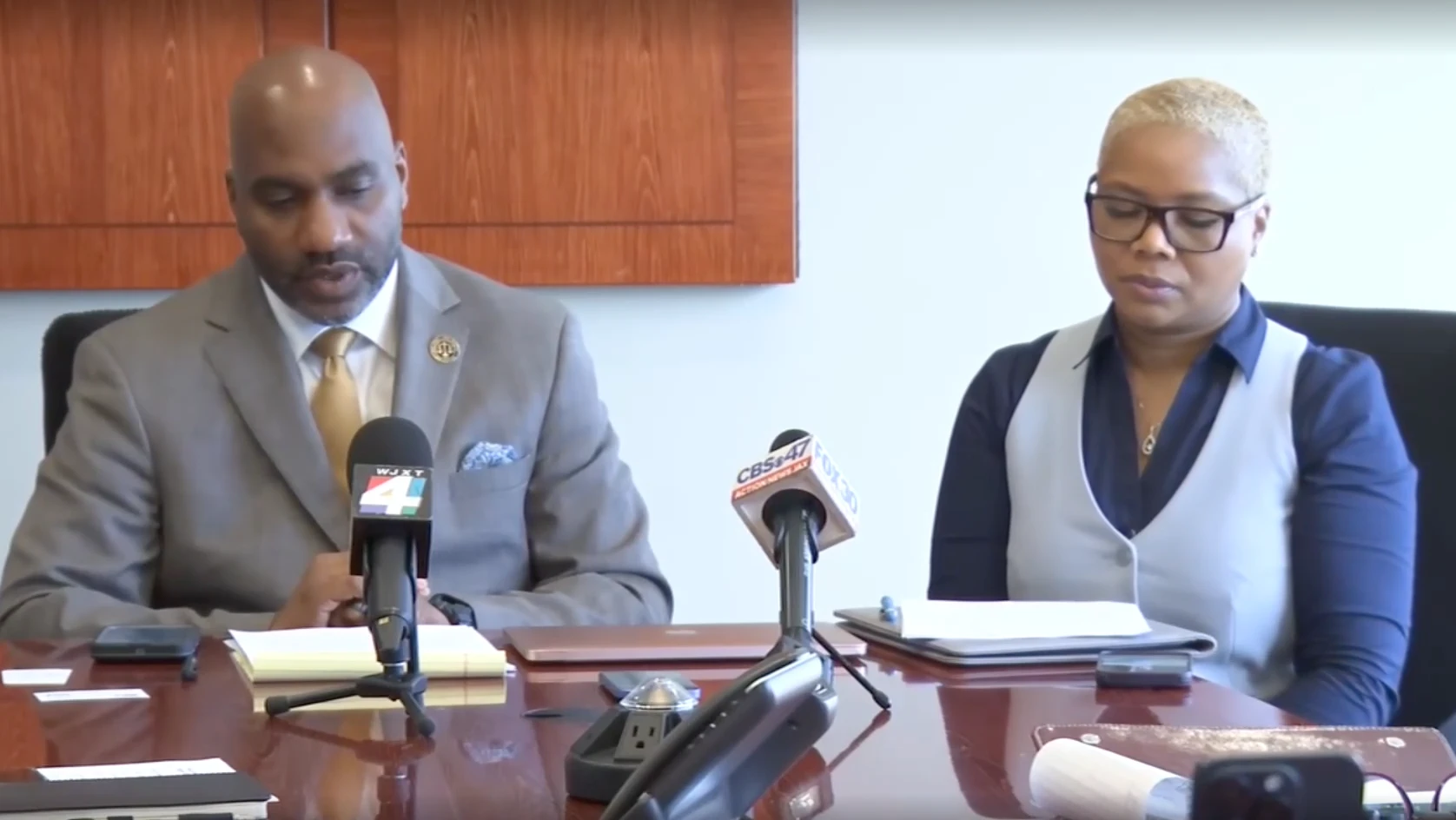
Jacksonville Attorney Lamonte Carter and iCity Christian School Executive Director Terrie Hairston announce a group of private schools' lawsuit against Step Up For Students on Friday, Feb. 20, 2026. | News4Jax
Published on February 22, 2026 at 5:40 pm
Free local news and info, in your inbox at 6 a.m. M-F. Sign up for the Jacksonville Today newsletter.
A group of private school owners have filed suit against Step Up for Students, the Jacksonville company in charge of handling half a million school choice vouchers in Florida. The suit, which alleges Step Up For Students mishandled payments owed to the schools, comes amid a growing call for legislative reform to the school choice program from state- and district-level stakeholders, schools and families.
Step Up For Students is the largest of three funding organizations the Florida Department of Education designates to disburse funds to families who utilize the state’s robust school choice programs.
Jacksonville Today thanks our sponsors. Become one.
Recent state audits of the funding organization and the Education Department revealed funds disbursed to families through Step Up For Students have been mismanaged, and the school choice program has been plagued with inconsistencies and accountability issues that have resulted in voucher payment delays to students and schools — and some frozen funds.
At a press conference Friday announcing the suit, the suing schools’ lawyer, Lamonte Carter, said the group’s goal is to “reform and improve” the program.
“Part of the reason we filed a suit is to not only advocate but educate,” Carter said.



Jacksonville Today thanks our sponsors. Become one.
The schools’ difficulty in receiving correct payments from the state date back five years, according to the suit, and Carter says it equates to a loss of “$500,000 to a million” for each school in “unpaid scholarships” and other indirect expenses related to the state payments.
Step Up For Students spokesperson Scott Kent told Jacksonville Today in an email the schools’ claims of mismanagement are specific to their schools and not reflective of the program as a whole.
“Step Up For Students is disappointed that the schools have chosen to file a lawsuit, which we believe is motivated by their goal of effecting policy and legislative changes, which would undermine anti-fraud controls,” he wrote. “We will work with our attorneys to address the allegations the schools have raised and respond accordingly.”
Signs of trouble
State funding for Florida’s schools is based on enrollment, which the state tracks at checkpoints during each school year. Student censuses each October and February underpin the calculations that become quarterly payments sent to school districts and voucher money released for students not in public schools.
In October 2024, the survey found 23,000 students who were counted by both a school district and a scholarship funding organization. In an effort to correct this, the state froze their scholarship funds. Still, when it was time to send school districts the fourth quarterly payment of the school year, in Spring 2025, the state was short $47 million. Duval Schools’ share of that shortfall was $2.3 million, which it did eventually receive months later.
Ahead of the current legislative session, K-12 budget and appropriations committees in the state Senate and House analyzed what caused the fiscal fiasco last year.
“It’s important to note that these weren’t new issues to last year. They’ve existed prior to our last year,” Rep. Jenna Persons-Mulicka, R-Fort Myers, said during a committee meeting in October 2025. But, because of the increased number of parents who are choosing options other than traditional public schools, “they were more impactful in 2024-25.”
Some critics say the state formula used to calculate education funding is outdated. Counting students only twice a year, for example, can lead to money — intended to follow the student — staying with a choice program even after a student transfers to a public school mid-year.
The need for a system to cross-check student enrollment is high on the list of solutions; school districts including Duval are advocating in Tallahassee for adjustments to the school choice funding model they say would “align funding with real-time student enrollment.”
“It’s not as simple as just saying, ‘At this particular date certain that school districts report on, where was that student, and they’re going to be funded,’” Osceola Schools CFO Sarah Graber told a House committee in October.
‘Unprecedented demand’
Florida’s school choice program — a broad header that includes public funding of privately operated charter schools; vouchers for private school tuition; subsidies for homeschoolers; and scholarships for students with “unique abilities” — has grown exponentially in recent years.
In 2023, Gov. Ron DeSantis signed off on an expansion that opened privates school vouchers to all Florida children, regardless of income (though preference is given to low- and middle-income families). Supporters praised the expansion as supporting parents’ rights, while critics cautioned that diverting funding could undermine the stability of the state’s traditional public school system.
On Friday, the same day the private schools announced their suit, the state Board of Education renewed contracts for Step Up For Students and AAA Scholarship Foundation to serve as Florida’s scholarship funding organizations. The board also approved a new organization, Sunshine State Kids Foundation, to administer scholarships.
Funding organizations can use up to 3% of their revenue to cover administrative costs, though the state Legislature is currently debating reducing that figure to 2%.
Step Up is the largest of the three funding organizations. Founded in 2000 by long-time school choice advocate John Kirtley, the organization has grown with the state’s school choice programs.
Last year, it received scholarship applications from more than 500,000 students. (In contrast, AAA, founded in 2010 by former Step Up CFO Kim Dyson, saw about 10% of that.) Step Up’s recent tax filings show its annual revenue hovers around $1 billion.
Since November, when the state auditor general presented to the state Senate the report breaking down last summer’s financial shortfalls, lawmakers’ support for school choice programs has remained strong, even as school choice staff received a searing rebuke.
“I want to stress that the purpose of today’s meeting, senators, is not to cast blame or focus on the past,” said committee Chair Sen. Danny Burgess, R-Zephyrhills, in November. “So I hope that sets the appropriate tone and tenor for the meeting. We should all be very proud of the direction we’re going and we should all be looking at how we can make sure that this program lives up to its full promise and potential that we outlined very swiftly a few years ago and that we can work together to do just that.“
The state auditor described a workflow that released money first, and then sometimes had to work to get it back. Scholarship application deadlines didn’t align with the Legislature’s funding cycle, and families sometimes chose not to attend a program they’d received funding for. All of this led in some cases to duplicate payments or scholarship accounts that far exceeded the established limit, and it caused the $47 million shortfall that delayed school districts’ funding.
Another issue the report identified: The Education Department had a very manual process of tracking down incorrect payments — something Sen. Clay Yarborough, R-Jacksonville, called a “pay and chase process.”
Florida school choice Executive Director Adam Emerson told a committee that for the 2024-25 school year, the department was legally obligated to send $655 million to the funding organizations before many families had made final decisions on where to send their children to school.
Sen. Jason Pizzo, I-Hollywood, said that the interest alone on the $655 million would have been about “$90,000 a day in float” — and therefore a major loss to state coffers to have given it to Step Up For Students to hold.
“I want to know, who’s getting the float?” he said.
Pizzo asked Emerson what his office needed to manage the program properly.
“Respectfully, and this is not a blame game…Perhaps we’re not giving you what you need,” Pizzo said. “Because wherever you were, sir, before doing this, you could never hand in these numbers at the end of the year. So what do you need?”
Emerson, whose LinkedIn profile says he served as the communications director for Step Up For Students before coming to the state Education Department in 2014, said that the new cross-check systems in progress would be a great help.
A bill by Panhandle Sen. Don Gaetz, R-Niceville, which unanimously passed the Senate, is aimed at bringing more efficiency and transparency to the state’s school voucher program by separating private school voucher funds from public school funds.
Schools’ claims
The schools behind the lawsuit, including iCity Christian School in Jacksonville, say they have cut educational programs that are critical to their students in the face of delayed voucher payments.
The seven plaintiffs in the lawsuit are:
- iCity Christian School in Duval County
- Square Pegs Learning center in Bay County
- Dickens Sanomi Academy and Diverse Abilities Center, both in Broward County
- Educational Harbor in Manatee County
- Mountaineer’s School of Autism in Palm Beach County
- Lakeland Institute for Learning in Polk County
State records list all the schools as serving students in kindergarten through 12th grade, and three also offer preschool.
Terrie Hairston, executive director of iCity Christian School in Jacksonville, said Friday the state’s scholarship program was “created to expand educational opportunity.”
“When the administration of those funds break down, schools face financial strain, families experience uncertainty, and students are placed at risk of service disruption,” she said. “Our purpose today is simple. It’s not political. It’s accountability. It is transparency, and it is ensuring that our programs funded for students operate as intended under the law.”
WLRN reporter Natalie La Roche Pietri contributed to this story.