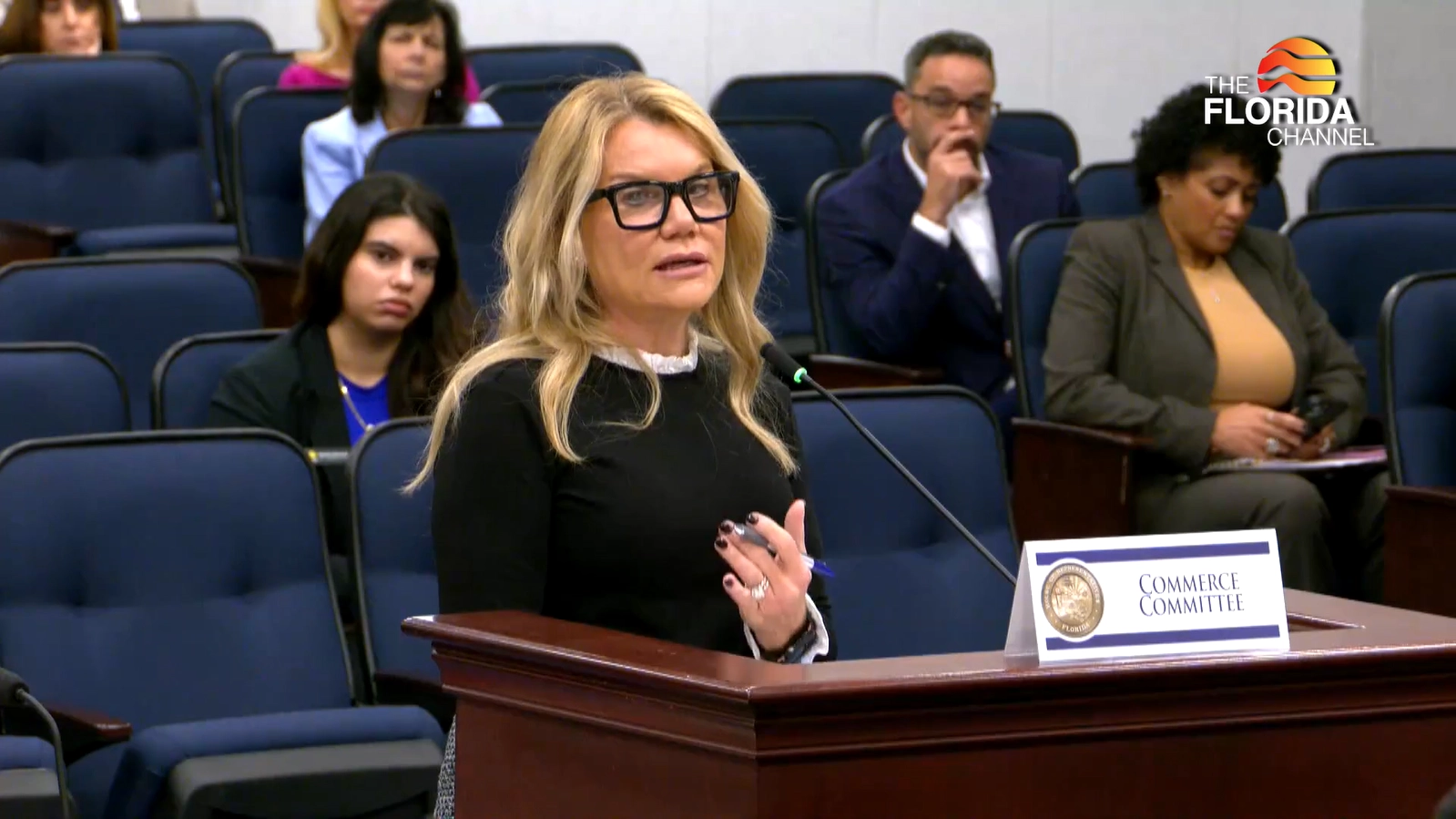
Rep. Lauren Melo, R-Naples, discusses the latest version of her proposed "Blue Ribbon Projects" bill before the House Commerce Committee on Wednesday, Feb. 18, 2026. | The Florida Channel
Published on February 20, 2026 at 11:03 am
Free local news and info, in your inbox at 6 a.m. M-F. Sign up for the Jacksonville Today newsletter.
Some counties in Northeast Florida are opposing a legislative proposal that would fast-track the development of large-scale projects, partly to create more affordable housing.
The bill has changed quite a bit since it was first introduced, but St. Johns County Commissioner Ann Taylor says HB 299, also known as the “Blue Ribbon Projects” bill, takes power away from governmental bodies closest to constituents.
Jacksonville Today thanks our sponsors. Become one.
“We believe growth should be shaped by the people who live in St. Johns County, not by a one-size-fits-all mandate from Tallahassee that allows developers to ignore our local planning foundations,” Taylor says.
There are still several steps before HB 299 gets a vote on the House Floor, but the bill has so far received bipartisan support.
What’s in the development bill?
According to HB 299’s House sponsor, Rep. Lauren Melo, R-Naples, the Blue Ribbon bill is another effort by Tallahassee to find solutions to Florida’s growing affordable housing crisis — and to support conservation efforts in the meantime.


Jacksonville Today thanks our sponsors. Become one.
If passed, the bill would allow for developments on properties larger than 10,000 acres to bypass local zoning rules if developers meet a number of requirements. Chief among them is that 20% of any housing must be affordable housing or “missing middle” housing, like duplexes and triplexes.
Another key requirement is that development on the massive tract of land must be clustered on 40% of its acreage, leaving the remaining 60% in what the legislation refers to as a “reserve area.”
The reserve area is designed to be a conservation area, with approved uses including wildlife corridors and passive recreation. Up to 15 percent of the reserve area can be what the bill identifies as “uses of public benefit,” which includes parks, but also utility facilities and reservoirs.
The reserve area could not be used for golf courses, data centers or solar farms.
Opponents have argued that some guidelines for developers lack measurable standards.
Other guidelines include:
- Limiting urban sprawl
- Promoting alternative mobility options to cars and trucks
- Achieving “a cleaner and healthier environment”
The initial version of the bill filed by Melo and Sen. Stan McClain, R-Ocala, in the Senate, would have allowed developers to entirely bypass municipal governments.
That element of the bill has since been altered. If the current version is made into law, Blue Ribbon projects would require two public hearings but still be able to bypass zoning and land-use rules.
When legislators discussed the latest version of the bill during a House of Representatives committee meeting Wednesday, advocates with organizations like 1000 Friends of Florida supported the changes but said the bill still needed work.
Gil Smart, policy director for Friends of the Everglades, told legislators that the bill still takes power away from local governments.
He says Melo’s bill is “nothing short of a declaration that local government comprehensive plans are null and void.”
We have a process for these things,” Smart said, “and this attempts to really truncate that process and expedite these projects.”
From the state to the local level
Taylor, the St. Johns County commissioner, is also worried about how HB 299 overrides local control. Taylor led the charge among the County Commission to oppose the bill in its earlier form, but she still opposes it.
Like Smart, Taylor worries that the bill would override comprehensive plans, the development plans that local governments spend years putting together.
“The bill still allows these massive 10,000-acre ‘Blue Ribbon’ projects to be established on land with any existing land use or zoning designation without requiring a standard comprehensive plan amendment or rezoning,” Taylor says. “This creates a state-mandated ‘parallel track’ that ignores our local Future Land Use Map, which the people of this county spent years developing to manage growth responsibly.”
Taylor is also worried that Blue Ribbon projects would allow up to 12 units per acre in residential areas and that taxpayers may foot the bill for nearby infrastructure.
Chadd Scott, conservation chair with the local chapter of the Florida Native Plant Society, is also not a fan of how the bill could affect the environment and rural communities.
He says he’s glad the “horrible” aspect of the bill that allowed projects to be approved without public input is gone, but Scott says large projects at the scale of 10,000 or more acres need more scrutiny, not less.
“These Blue Ribbon Projects would constitute rural development bombs,” he says. “There are long established processes for developers to follow when seeking new projects in every county in this state, this bill continues to be an end-around to those processes and in no way would mitigate sprawl or promote more sustainable, eco-conscious, smarter growth. Quite the opposite.”
During the committee hearing Wednesday, some lawmakers acknowledged their districts do not have more than 10,000 acres of vacant, developable land, but St. Johns County does.
One such area is part of a mosaic of different parcels totaling more than 31,000 acres, much of it concentrated north of Elkton and west of Interstate 95. According to the Jacksonville Daily Record, a New York real estate investment firm bought the land in 2020.
Elsewhere in Northeast Florida, told lawmakersClay County Commissioner Betsy Condon that a Blue Ribbon project could be built in her county, far from where the infrastructure residents need is concentrated.
But Rep. Melo, the bill’s sponsor, asserted that the bill is, from her perspective, a “creative solution” to providing affordable housing, walkable areas and conservation land.
Addressing concerns that her bill takes power away from city and county governments, Melo questioned whether those entities have done a good enough job managing things to begin with.
“If comp plans work, then why do we have an affordable housing crisis?” Melo asked. “If comp plans work, why are we all stuck in traffic, bumper to bumper, every day?”
Ultimately, the bipartisan Commerce Committee ruled favorably on the bill, with just two representatives of the more than 20-member committee opposing it. The bill still has one more committee stop before the entire House of Representatives could vote on it.
Editor’s note: This story was updated Feb. 23, 2026, with additional information about the proposed bill’s “reserve area.”