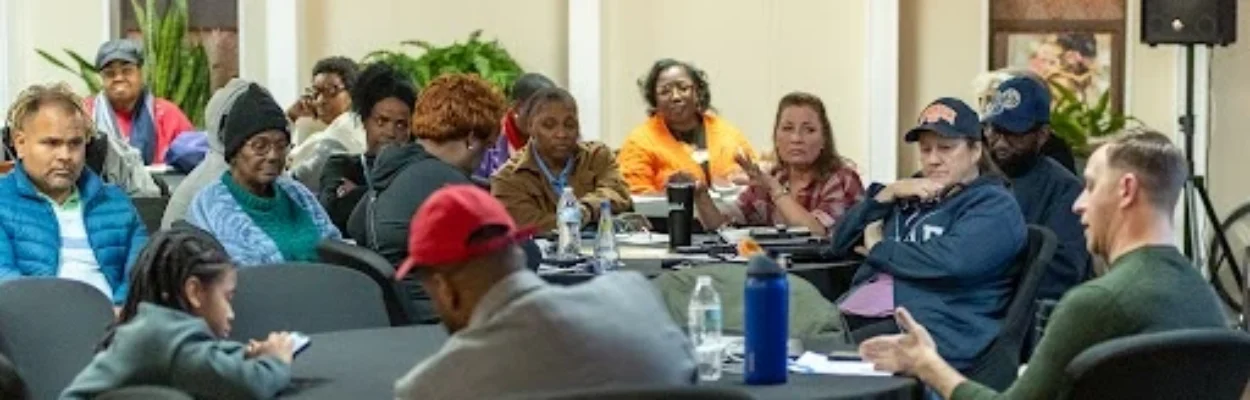
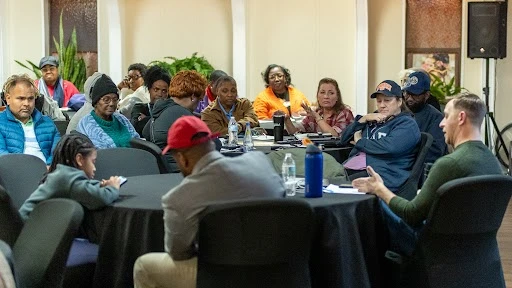
City Council member Jimmy Peluso held a town hall meeting with Eastside residents and advocates inside the Church of Oakland about the Community Benefits Agreement on Friday, Feb. 6, 2026. | Will Brown, Jacksonville Today
Published on February 18, 2026 at 10:41 am
Free local news and info, in your inbox at 6 a.m. M-F. Sign up for the Jacksonville Today newsletter.
Nearly a year and a half later, residents of Jacksonville’s Eastside now know how the city will divvy out $40 million in public funding set aside for their community in the Community Benefits Agreement with the Jacksonville Jaguars.
And leaders Out East and city officials say it should be only a matter of months before a newly minted Eastside Community Grants Program board is appointed and starts awarding dollars to projects in the area’s five neighborhoods.
Jacksonville Today thanks our sponsors. Become one.
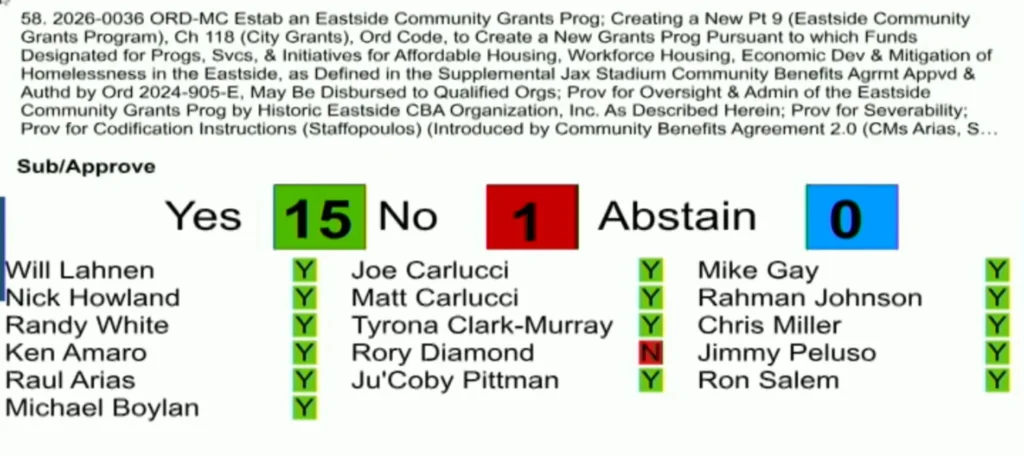
The Jacksonville City Council voted 15-1 on Feb. 10 on Ordinance 2026-0036, which forms a nine-member board appointed by the mayor, City Council president and the Jacksonville Jaguars to manage the program.
The $40 million is the city’s commitment to the Eastside in the $300 million CBA with the Jaguars negotiated as part of the Everbank Stadium renovation plan approved in 2024.
For its part, the Jaguars will invest $75 million in the Eastside located just north of the stadium district. The Jaguars will manage its portion of the Eastside investment, paid through $2.5 million installments between 2028 and 2058.
Jacksonville Today thanks our sponsors. Become one.
The city board structure is similar to the city’s Opioid Settlement Proceeds Grants committee, which manages $47.5 million Duval County received from a state legal settlement with drug manufacturers for opioid addiction.
That board makeup became known as the “Opioid Model” for Eastside residents working with city officials on how to spend the public investment.
Council members said Feb. 2 that the first $4 million could be available for grant applications within nine months. Under the bill, in the first year, all four focus areas of the Eastside grant program would get 25% of the available funding — affordable housing, workforce housing, economic development and mitigation of homelessness.
Until this month, it was widely expected the council would authorize the creation of an independent nonprofit group to manage the funds based on how the Cultural Council of Greater Jacksonville awards cultural service grants using city dollars.
That was the intent of Jacksonville’s Special Committee on the Community Benefits Agreement 2.0, led by council members Jimmy Peluso and Raul Arias.
As the legislation made its way through committees and on the night of the final vote, council members agreed to a last-minute change back to the Opioid grant model.
Eastside opinions
Ariane Randolph is a generational resident of the Eastside and owns a home in the community left to her by her grandmother Alberta C. Johnson. She’s also the Eastside Project Health Program director for the Eastside nonprofit Lift Jax, which is working to eliminate generational poverty in the area.
Randolph supported the Cultural Council model. But she tells Jacksonville Today the important thing is how quickly the first $4 million from the CBA is awarded, that the recipients and programs are vetted, and that the city can learn from the drawn out process.
“Hopefully, the city can use it as a lesson to say, we’re doing a great thing. This has never been done before and … the world is watching us. … We’re a living case study (with the CBA),” she said.
Council member Ron Salem sat on the CBA committee and was the only lawmaker on the panel to oppose creating the independent nonprofit. He introduced changes to bill that moved back to the opioid model.
Salem pushed for the pivot after the City Council auditor and inspector general worried the city would abdicate oversight and control of the money with the nonprofit model.
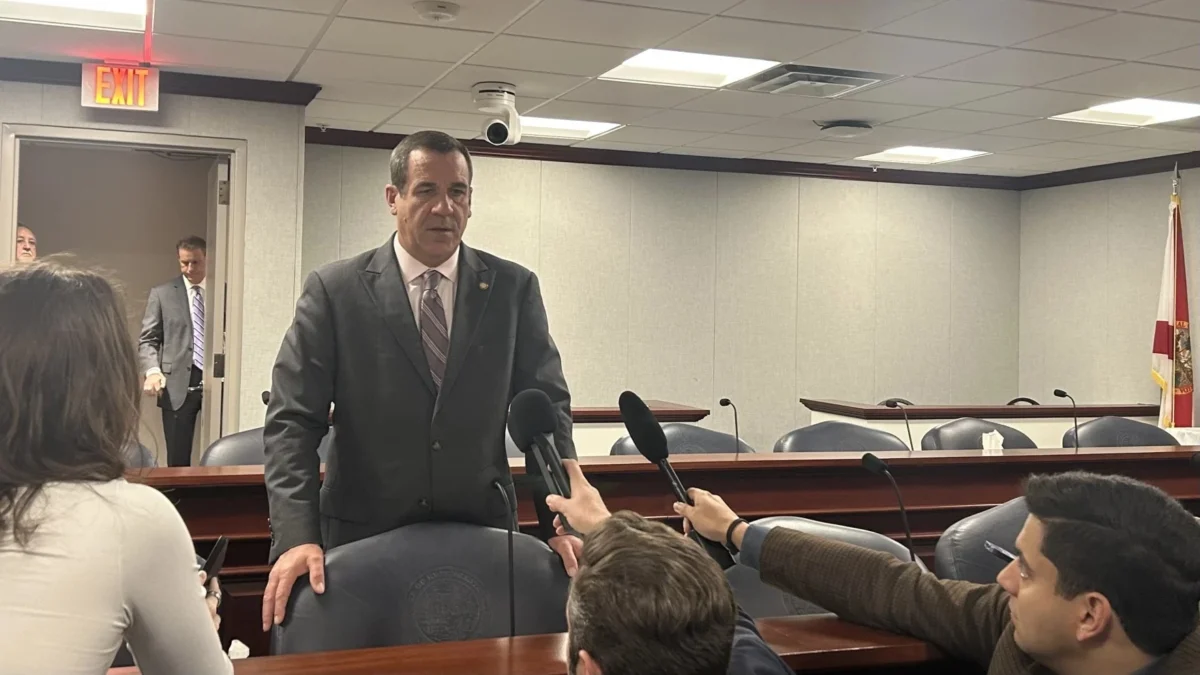
“These are taxpayer dollars, and I think it’s extremely important that we have control of those dollars,” Salem said during a committee meeting Feb. 2.
Some Eastside residents agree. Together Eastside Coalition Inc. member Latavia Harris told council members during the meeting that a city-appointed board could lead to less overhead costs to vet and administer the grants and more money on the ground in the Eastside.
“This is a one and done from the Eastside community. We have been under-resourced. We deserve this money to go correctly,” Harris said. “Yes we would probably be paying administrative fees, but they will still be maybe equal or less than what we’re going to pay one executive director.”
The mayor and City Council president split the appointments of eight of the nine voting members to the Eastside Grants Committee. The ninth spot will be reserved for a current employee of the Jaguars.
The legislation sets limits on how many appointees can reside or own businesses in any one Eastside neighborhood, so every area — Campbells Addition, Fairfield, Longbranch, Oakland and Phoenix — has representation.
The bill also creates a position to manage the program — a city employee housed in the Grants and Contract Compliance Division of the Finance Department. This person will help the committee members vet grant applications from businesses and organizations as they’re scored, monitor compliance and ensure City Council receives quarterly progress reports.
The manager also will act as a guide to help Eastside businesses and residents navigate the application process.
Council member Rory Diamond was the only no in last week’s vote. Council President Kevin Carrico and members Terrance Freeman, Reggie Gaffney Jr. were absent for the vote.
Lift Jax President and CEO Travis Williams told Jacksonville Today that the nonprofit intends to apply for funding through the program and would announce project proposals soon.
“We want to make more catalytic projects like Debs Store happen. We want to make more housing investments happen to help the neighborhood maintain its affordability but also get people pathways into the neighborhood,” Williams said. “We want to see catalytic work and projects happen along the commercial corridors of the neighborhood.”