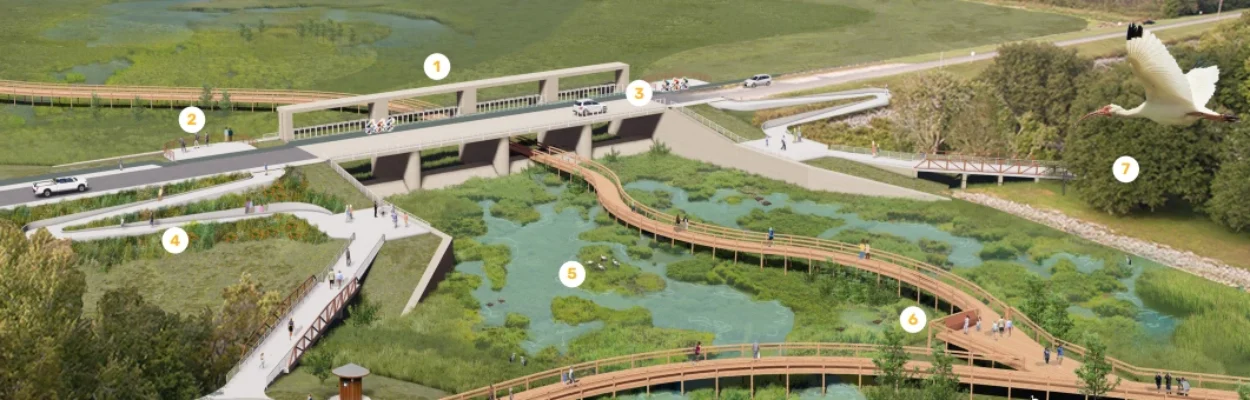
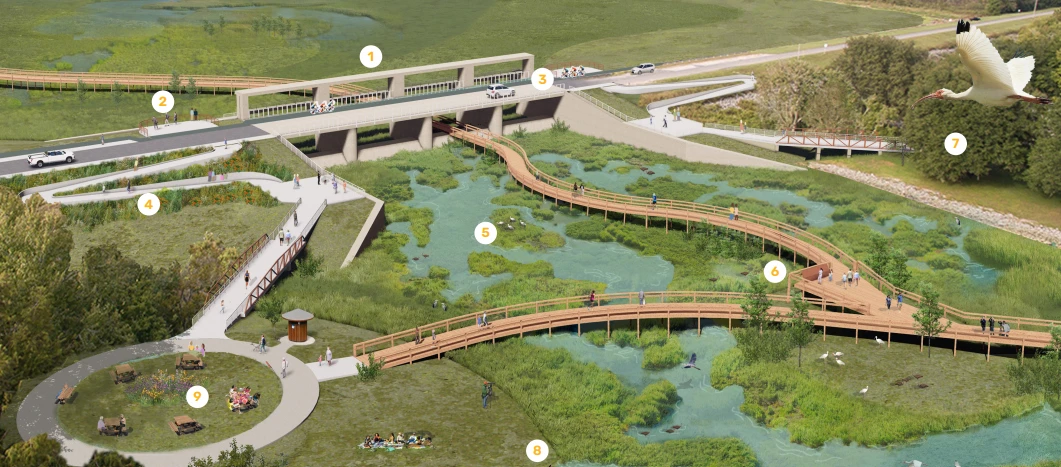
A conceptual rendering of proposed changes to the Kirkpatrick Dam in the Rodman Recreation Area in Putnam and Marion counties. | State of Florida
Published on February 11, 2026 at 11:18 pm
Free local news and info, in your inbox at 6 a.m. M-F. Sign up for the Jacksonville Today newsletter.
A renewed effort to remove a portion of the Kirkpatrick Dam and restore the Ocklawaha River to its natural flow in Putman and Marion counties will face its final committee hurdle Thursday in the Florida Senate.
Senate Bill 1066, introduced by Sen. Jason Brodeur, R-Sanford, faces its final stop before arriving on the Senate floor. The House version, by Rep. Wyman Duggan, R-Jacksonville, already passed through committees unanimously.
Jacksonville Today thanks our sponsors. Become one.
This is the closest that longtime advocates of draining the Rodman Reservoir and restoring the river have been to gaining Tallahassee’s support.
“It doesn’t do any of the things that dams often do,” Duggan tells Jacksonville Today. “It doesn’t generate electricity. It doesn’t create a source of drinking water. It doesn’t have a role in flood control. It was built only to create a big puddle of water for the Cross Florida Barge Canal, which was terminated…because of environmental impacts. So it’s an artifact. It’s a relic.”
The 58-year-old Kirkpatrick Dam holds back 21 billion gallons of water in the Rodman Reservoir on the Ocklawaha, the largest tributary of the St. Johns River.

Jacksonville Today thanks our sponsors. Become one.
Environmentalists say the dam has caused ecological damage to aquatic plant life downstream and prohibits migratory fish from moving freely through the river system. The reservoir and Rodman Recreational Area draw thousands of outdoor tourists and anglers annually.
The so-called Northeast Florida Rivers, Springs, and Community Investment Act would restore the Ocklawaha River and its floodplain to what it was before the canal’s construction.
The legislation says removing 2,000 feet of the dam would be enough to return the river to its natural flow. The bill also would create a grant program to assist river communities in Clay, Marion, Putnam, and St. Johns counties to implement new recreation plans.
The grants would be awarded by a 16-member advisory board, with nine members appointed by the governor. The panel would have representatives of river recreation-related businesses local to Marion or Putnam counties, as well as members who represent fishing interests and the commanding officer of Naval Air Station Jacksonville or a designee.
The bills would require the state Department of Environmental Protection to complete an implementation plan by July 2027 and finish the project by Dec. 31, 2032.
Officials estimate it will cost $70.03 million over four years to restore the river.
Conceptual renderings of the modified dam system provided by Duggan show a new dock, boardwalk and trail network built around the restored river.
Although breaching the dam would take away the reservoir and spillway flows that support existing fisheries, state officials say improving the Ocklawaha and lower St. Johns River access for boat and shore-based anglers could offset some of the impact.
Duggan points to a 2024 report that shows a $20 million in increased annual economic impact within 10 to 20 years of restoring the Ocklawaha River. According to the study, the cumulative net benefits over 20 years are estimated at $198.23 million – a $2.09 return for every $1 invested.
Quinton White, a retired 48-year professor of biology and marine science at Jacksonville University and the founding executive director of the school’s Marine Science Research Institute, worked on the report.
He says the reservoir already has to be drawn down every three to five years to reduce excess nutrients and biomass and control invasive plant species build up behind the dam.
The reservoir is in one of those drawdown periods now. White says fishing doesn’t stop when the water level is low.
He expects the river ecosystems to bounce back quickly after the restoration.
“A very valuable forested wetland system was destroyed when they submerged the land. And that system has a chance now to return,” White said. “And I think people are going to be surprised at how quickly it happens. Because just within a matter of months you start seeing these trees try to sprout.”
Debate among locals
Communities in Putnam County have been split throughout the decades-long debate over whether to keep the reservoir.
There’s been talk among environmentalists and other groups of restoring the river since the 1970s. In 1993, the Florida Legislature first directed the Department of Environmental Protection to study the impacts.
For some locals and environmentalists, draining the 9,500-acre man-made lake – technically called an impoundment of the river – would uncover 20 fresh water springs submerged by the reservoir and restore natural river ecosystems. Proponents say it could also reduce the salinity of the St. Johns River with more fresh water flowing in from the Ocklawaha.
State elected leaders and the U.S. Army Corps of Engineers have warned of property damage and possible loss of life should the dam ever fail.
An independent study of the dam completed in 2005, cited in Florida Senate staff analysis of the legislation, says an 11,000-acre area with 538 properties downstream could see a total loss of $57.4 million in damage.
“But most importantly, there’s no alarm system in place,” Duggan said. “And if the dam failed at 2 a.m. in the morning, nobody would know. There’d be no way to warn anybody downstream of the risk. It’s a dangerous situation.”
Linda Myers, a former Putnam County tax collector, former county commissioner and president of the Great Florida Riverway Trust, says whether to restore the river is an “extremely passionate issue” for Putnam County. She feels the latest proposal has done a better job at answering community questions than previous efforts, and she supports it.
Local officials like Palatka Mayor Robbi Correa and Welaka interim Mayor Kathy Washington have spoken to the legislative committees in support of the project.
Myers says many of the advocates for keeping the dam weren’t alive when it was built and “never knew the river.”
“There are people that just know the reservoir. So, for them, I’ve heard many times, you have a natural 50-year-old environment there. Why would you change that? In reality, it is not a resilient environment,” she said.
On the other hand, other local officials are sympathetic to anglers who take advantage of the reservoir’s premier bass fishing and boating, fear the legislation would drain a beloved local resource. Larry Harvey, a Putnam County commissioner and executive director of Save Rodman Reservoir Inc., believes the talk of draining the reservoir is more about politics than protecting the environment.
“How would you like somebody to be in your backyard telling you what you should do in your area? We don’t like it here in Putnam County. We have our citizens (who) want the reservoir,” Harvey told Jacksonville Today. “…It’s our water, it’s our environment, and it’s our decision to make – not out-of-town legislators who want higher office, and they’re doing this just to get elected in purple regions.”
The Save Rodman Reservoir nonprofit has a Facebook group with about 5,500 followers and helps organize the annual Save Rodman Open Bass Tournament.
Residents Putnam County linked to the Save Rodman group testified last week opposite supporters of the plan in front of Senate committees.
Debate in Jacksonville
The debate has also made its way to the Jacksonville City Council. By the end of the month, city lawmakers are expected to consider a bipartisan resolution filed by council members Jimmy Peluso and Micheal Boylan urging the Florida House and Senate to send the river restoration plan to Gov. Ron DeSantis.
Even though the Ocklawaha is the St. Johns River’s largest tributary, Harvey has been critical of the Jacksonville lawmakers’ desire to weigh in and jumped on recent comments made by Peluso that the plan would make a JEA water source cleaner.
The Save Rodman group is also starting a campaign to reach out to Jacksonville City Council members and attend meetings to speak out against the resolution.
“To clarify, THEY NEED OUR WATER! A simple ride through West Putnam County and you will see how the massive withdrawals by urbanized area(s) (have) already devastated our lakes and the property values tax base that funds government services,” a post Tuesday on the Save Rodman Reservoir Facebook Group says.
Harvey tells Jacksonville Today that opponents are preparing for the plan to pass the Legislature. The Save Rodman group has now shifted its strategy to petitioning the governor’s office to veto the bill.
What will DeSantis do?
During a visit to Mayo Clinic in Jacksonville in January, DeSantis said his view on the dam’s value has not changed since he line-item vetoed a budget appropriation last year that would have set aside funding for the river restoration project.
“I felt keeping it status quo was the right thing to do,” DeSantis said during the appearance in Jacksonville. “I’m not sure that anything’s changed since I acted last year. But, you know, it was something that we thought about very seriously.”
According to Duggan, Brodeur and he filed the bills after the governor said he wanted the Kirkpatrick Dam debate to happen through its own legislation and not as part of the budget appropriations process, as happened last year.
Going into Thursday’s committee hearing, Republican Sen. Stan McClain, whose district includes Marion County, is the only state lawmaker to vote against the bill.