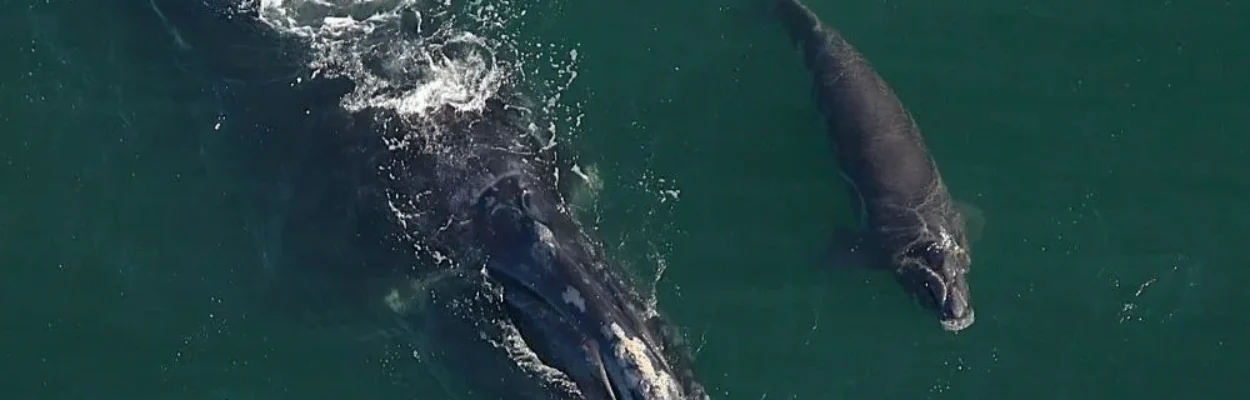
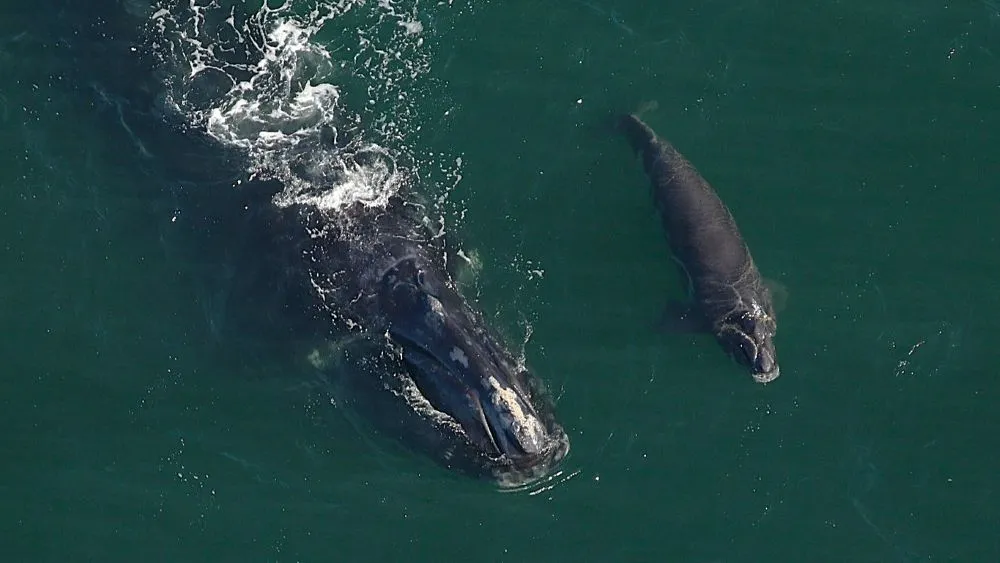
A right whale named Boomerang and her new calf were spotted about 9 miles east of the St. Mary’s River entrance in Florida on Jan. 1, 2026. | Clearwater Marine Aquarium Research Institute
Published on January 8, 2026 at 10:40 am
Free local news and info, in your inbox at 6 a.m. M-F. Sign up for the Jacksonville Today newsletter.
The New Year has brought a new baby right whale to the waters near Jacksonville — one more member of an endangered species of marine mammals.
An aerial survey team saw a right whale named Boomerang and her new calf about 9 miles east of the St. Mary’s River entrance in Florida on Jan. 1.
Jacksonville Today thanks our sponsors. Become one.
The mother was last seen Dec. 20 without a calf, making this baby less than 2 weeks old, according to the National Oceanic and Atmospheric Administration.
Boomerang is 31, and this is her fifth known calf, born in the middle of the right whale calving season, which runs from mid-November to mid-April. Boomerang was named for the boomerang-shaped white scar on the underside of her fluke, NOAA says.
Boomerang last gave birth in 2019 to a male calf, seen as recently as last year. Her only female calf, Frisbee, was born in 2009, NOAA said.


Jacksonville Today thanks our sponsors. Become one.
Researchers have identified 15 calves born so far this calving season to the estimated 70 females able to give birth out of the approximately 380 endangered right whales remaining in the world.
Researchers closely monitor the ocean during each year’s right whale calving season, since so few remain. In December, an endangered North Atlantic right whale named Division was rescued from entangled fishing lines off the coast of St. Marys, NOAA says.
Federal and state wildlife researchers cut a number of heavy fishing lines off the whale after seeing that they had cut deeply into a fin. Researchers had hoped the rest of the thick lines entangling the 3-year-old male whale would fall off as he continued his migration southward.
Along with the Atlantic Ocean coastal waters, a few right whales have been documented in the Gulf. Boomerang brought her first calf there in 2006.
The calf was named Lone Star after being spotted as far west as Corpus Christi, Texas. Researchers have not seen Lone Star since 2016 and he is presumed dead, NOAA says.