
Published on January 7, 2026 at 11:57 am
Free local news and info, in your inbox at 6 a.m. M-F. Sign up for the Jacksonville Today newsletter.
Located six miles southeast of Downtown Jacksonville, Sans Souci is a mid-century community with a distinctive story, situated along Dean Road, just west of University Boulevard and south of Beach Boulevard. Here are six historical facts about Sans Souci that you might not know.
1. Sans Souci was developed as a planned community

Sans Souci was developed as a planned community by the Adolph Wurn Corp., founded by Adolph Wurn (1890–1974). Born in Lwów, Poland, in 1890, Wurn immigrated to the U.S. and moved to Jacksonville with his wife, Clara, in 1921, where he opened a grocery store. He began building houses in 1928 in neighborhoods such as Fishweir Park, St. Johns Park and Murray Hill.
Jacksonville Today thanks our sponsors. Become one.
In 1935, the Wurns expanded into real estate development. A longtime member of Temple Ahavath Chesed, Wurn went on to develop several neighborhoods throughout Duval County in addition to Sans Souci. These included Fort Caroline Club Estates, Colony Cove, Fairways Forest, Old Mill Cove, South Shores and Glynlea Park. He also constructed more than 1,500 homes in the Arlington area.
2. The pride and joy of the Adolph Wurn Corp.

Developed by the Adolph Wurn Corp. in 1955, Sans Souci was considered the pride and joy of the Wurn family. Named from the French phrase meaning “without care,” Sans Souci was initially envisioned as a planned community of 600 homes. Modern features of the development included a sewage disposal plant, curbed and guttered streets, and a five-acre tract set aside as a park and playground for residents.
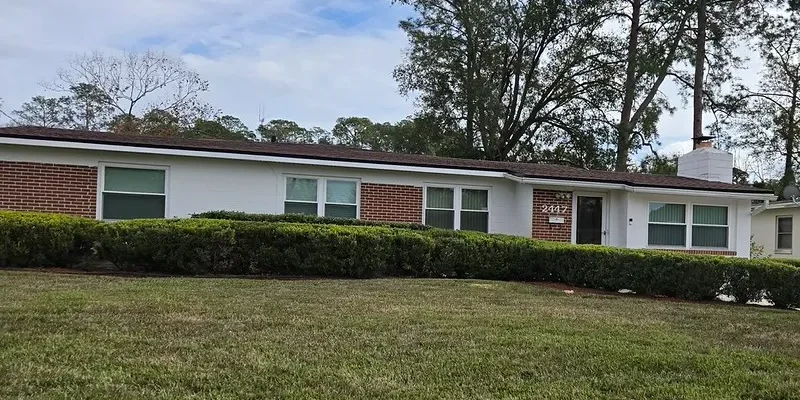
Peninsular Realty Co. served as the exclusive sales agent for the builders involved in the development, including the Wurn Construction Co., Leon Felhandler and Harold Blum. Initial home prices in Sans Souci’s first phase ranged from $10,950 to $13,200, with VA, FHA, and conventional financing available to prospective buyers. Most homes were ranch-style residences constructed of concrete block, either painted or jumbo brick, and were offered in 25 different floor plans. Typical homes featured three bedrooms and one-and-a-half or two bathrooms, with sizes ranging from approximately 1,000 to 1,400 square feet.

Jacksonville Today thanks our sponsors. Become one.
In 1957, a 150-home expansion was launched on 50 acres just west of Adolph Wurn Park. By that time, 310 homes valued at more than $4 million had already been built and occupied. By August 31, 1958, 500 homes had been sold in Sans Souci, with an ultimate goal of 1,200 home sites at full build-out.

3. The nation’s first fully equipped recreational area deeded to a county

Adolph Wurn Park was reportedly the first park in the nation in which a developer deeded a fully equipped recreational facility to a county. Located in the heart of the Sans Souci community, the park was developed by the Adolph Wurn Corp. with an initial investment of $150,000. The five-acre space originally included a swimming pool, rec center, basketball court and other amenities. Two baseball fields were later added and were used for games organized by the Sans Souci Athletic Association, founded in 1954.
The Adolph Wurn Corp. officially opened Adolph Wurn Park in November 1955 and donated it to Duval County. It was dedicated to promoting better living throughout Duval County, with particular benefit to the residents of Sans Souci.
4. Sans Souci: The birthplace of Burger King

Inspired by the success of the original McDonald’s restaurant, Jacksonville residents Keith Kramer and Matthew Burns founded Insta-Burger King on July 23, 1953. The chain’s first location was located at 7146 Beach Blvd., just east of what became the neighborhood of Sans Souci two years later. In 1954, James McLamore and David R. Edgerton acquired a license to open their own Insta-Burger King franchise in Miami.
McLamore and Edgarton purchased the national rights to the fast-growing chain and rechristened the company Burger King in 1959. Since Burger King’s founding, the Miami-based company has grown to become the world’s second largest hamburger chain and the third largest fast food company in the industry. With well over 14,000 restaurants in nearly 100 countries that serve an average of 11 million hungry guests every day, Burger King is second only to McDonald’s in the hamburger business.
The original Insta-Burger King building in Jacksonville still stands and has long remained in use for food-related businesses. For years it was occupied by a Stan’s Sandwich Shop, and it’s currently home to La Favorita Grocery Store and eatery.

5. A medical powerhouse

Following its opening in 1955, the area surrounding Sans Souci developed into an important medical district anchored by HCA Florida Memorial Hospital and Brooks Rehabilitation Hospital, located near the intersection of University and Beach boulevards.
Both institutions trace their origins to 1969, when a group of physicians and community leaders established Memorial Hospital in response to Jacksonville’s growing population and a shortage of hospital beds. Memorial Hospital originally opened with 99 beds, with Dr. J. Brooks Brown serving as chairman of the board.
Cathedral Rehabilitation Hospital opened in 1970 and was acquired by Memorial Hospital in 1982, becoming the Memorial Regional Rehabilitation Center and the region’s only hospital-based rehab facility. In 1995, Memorial Hospital was sold to HCA Healthcare; however, the rehabilitation hospital was not included in the sale and was renamed Genesis Rehabilitation Hospital. In 1999, it was renamed Brooks Rehabilitation Hospital in honor of Memorial’s founder, Dr. J. Brooks Brown. Today, HCA Florida Memorial Hospital is a designated Level II trauma center and a 454-bed, full-service acute care medical facility.

6. Sans Souci’s ranch-style architecture

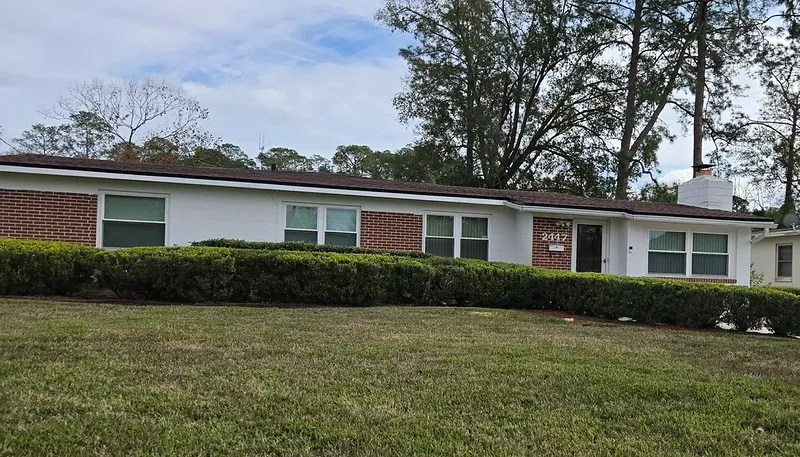
Sans Souci is known for its ranch-style residential architecture. A ranch-style house is a single-story home characterized by a long, low profile, open floor plan, and strong connection to the outdoors. Common features include a low-pitched roof, wide eaves, large picture windows, sliding glass doors, and an attached garage. Interiors typically emphasize informal living, with combined living and dining spaces and easy access to a backyard or patio.
Ranch houses became especially popular in Jacksonville and the rest of the country during the 1950s due to major social and economic shifts after World War II. Rapid suburbanization, fueled by affordable automobiles, highway construction and government-backed mortgages created demand for homes that were inexpensive and easy to build. The ranch style met these needs with simple construction and efficient layouts. It also reflected postwar ideals of comfort, privacy and family-centered living.