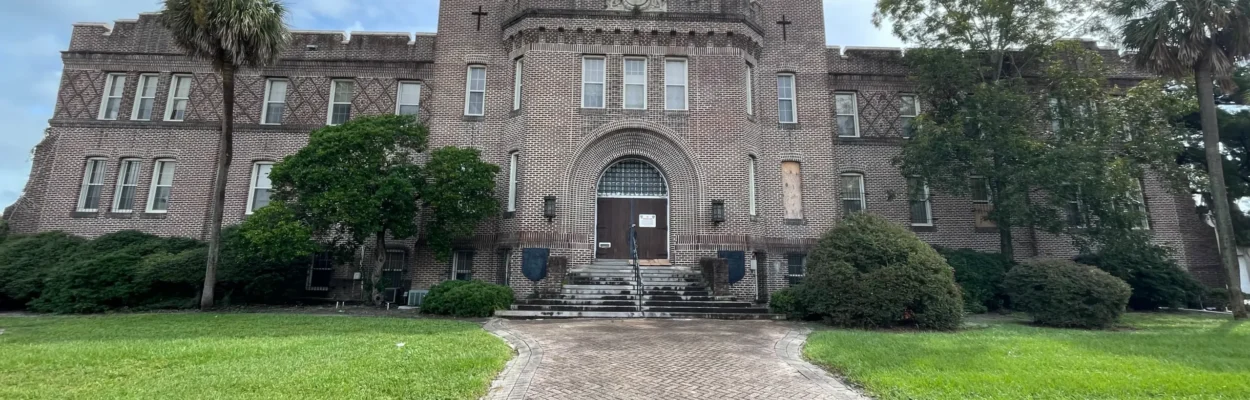
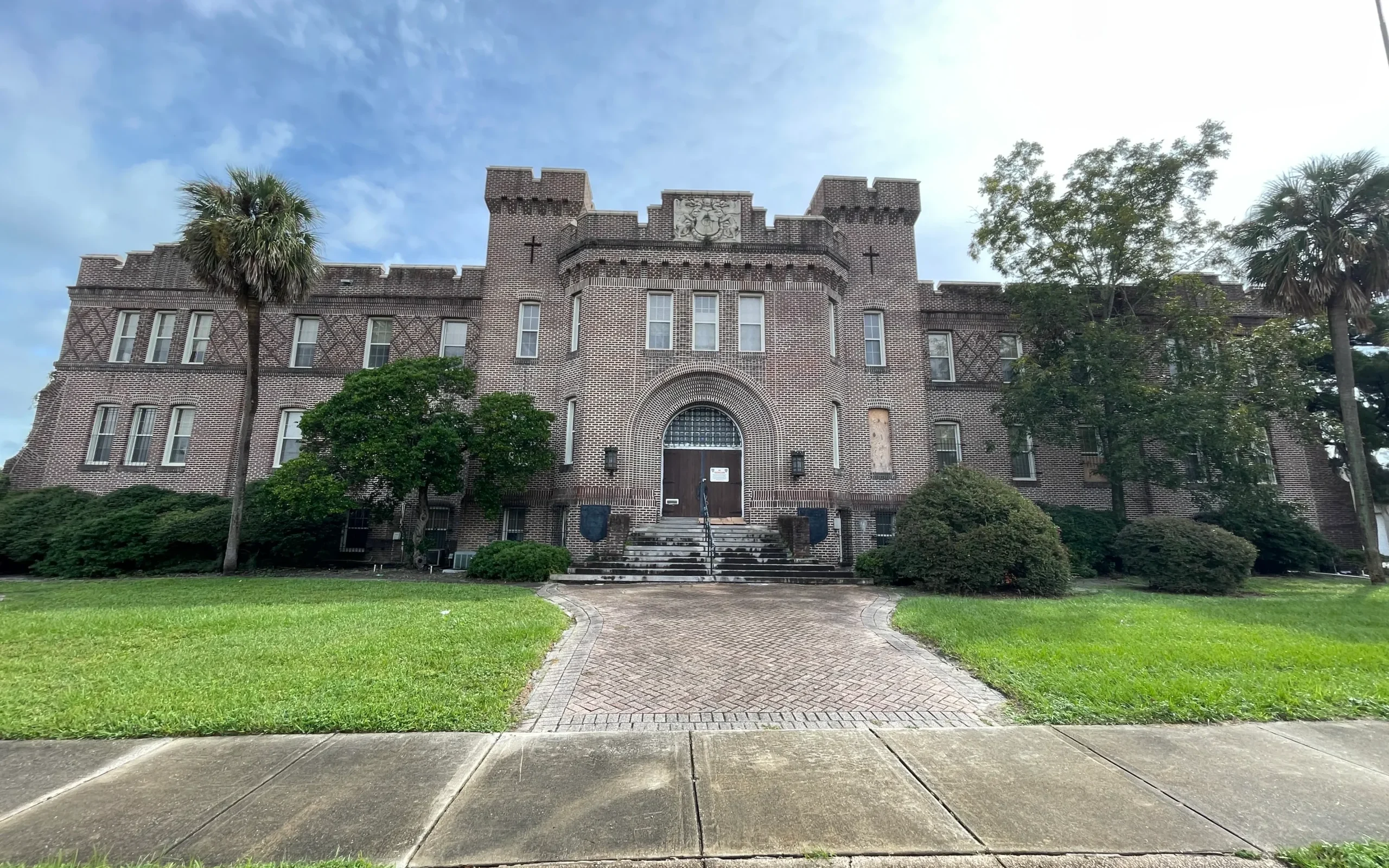
This historic Armory building, completed in 1916, sits south of Hogans Creek and north of State Street near Downtown Jacksonville. | Mike Mendenhall, Jacksonville Today
Published on January 6, 2026 at 9:39 am
Free local news and info, in your inbox at 6 a.m. M-F. Sign up for the Jacksonville Today newsletter.
After a back-and-forth with Jacksonville City Council members, city officials and a Fort Lauderdale-based nonprofit developer appeared to reach a final purchase price for the historic Armory building near Downtown.
The council’s Rules Committee amended legislation Monday afternoon to increase the proposed sale price of the 110-year-old Armory at 851 N. Market St. from $2.54 million to $3.04 million.
Jacksonville Today thanks our sponsors. Become one.
Economic development officials at City Hall spanning two mayoral administrations have been working with Reva Development Corp. LLC since 2020 when it won a request for proposals with its plan to restore and repurpose the old Armory into a food hall with artists spaces.
Reva agreed to the latest sale price Monday after city lawmakers voiced concerns that the sale price was lowered to cushion the developer from the project’s growing costs — specifically, reimbursing the city for a $496,537 community development block grant the organization was advanced under its last redevelopment agreement and lease, which has since been terminated.
Ed Randolph, director of the city’s Office of Economic Development under Mayor Donna Deegan, told council committee members that the city has also removed the option for Reva to build affordable housing on an adjacent 2.02-acre parcel of land to accommodate design changes to the nearby Emerald Trail.


Jacksonville Today thanks our sponsors. Become one.
He says that will make the project less lucrative for Reva. The developer also expects a $15 million cost for asbestos abatement and other code improvements. Randolph said the COVID-19 pandemic also delayed the project’s progress.
Reva heard pushback from some lawmakers during a meeting of the council’s Neighborhoods, Community Services, Public Health and Safety Committee. According to Randolph, the developer did not want to jeopardize the project or the land sale and agreed to the higher price.
Although supportive of the redevelopment plan, council members Ron Salem, Michael Boylan, Mike Gay and Ken Amaro thought the sale price was too low and should include a reimbursement of the block grant funds.
Gay, the lone no vote in the Neighborhoods Committee, flipped his vote to yes based on the new sale price.
“I think this will move the project forward. It keeps it clean. In my eyes at least, it reinforces the public’s confidence in this process that the table is level and we’re all playing fair,” Amaro said during the Rules Committee meeting.
“I think the development wants to move along and get this project moving, and I as a citizen would like to see it get going as well.”
The city did not seek an outside appraisal on the 2.49-acre property, and the sale price in Ordinance 2025-0876 was based on a price negotiated during Mayor Lenny Curry’s administration of $1.023 million per acre.
According to council documents, the Duval County Property Appraiser’s 2026 assessment could value the property at about $3.2 million.
If successful, Reva’s plans for a food hall and artist spaces follow trends in cities like Dallas, Nashville and other major metro areas of transforming historic structures into multitenant eateries and event venues.
The Rules Committee voted 7-0 to advance the deal after the 5-1 vote by the Neighborhoods Committee.
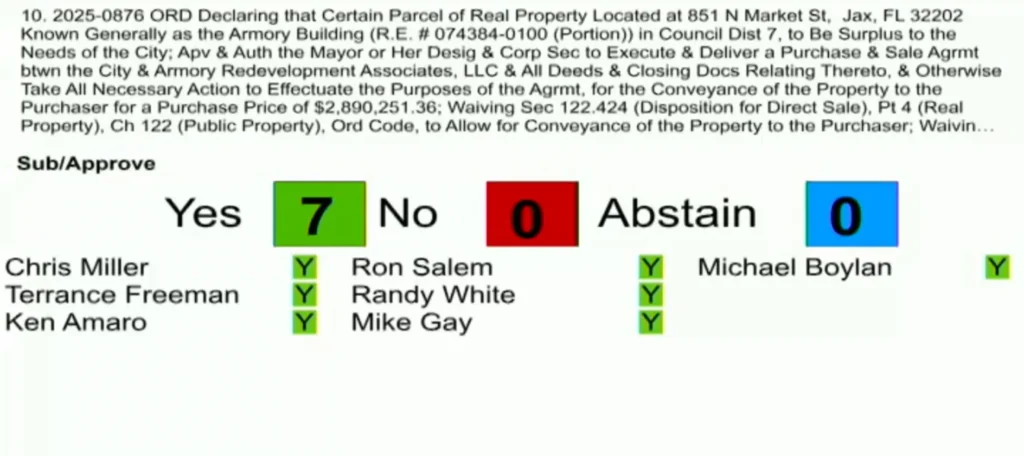
The Council Finance Committee followed the lead of the other two committees and advanced the legislation Tuesday in a 6-0 vote. The deal could see a final vote by the full City Council at its next meeting, on Jan. 13.
The Armory has been referred to several names over the years, including the Jacksonville Armory, Duval County Armory and National Guard Armory.
The Gothic-Revival style building was completed in 1915-16, designed by architects Talley & Summer and used as a facility for local National Guard troops, according to the Jacksonville History Center.
It also appeared perennially on the history center’s Endangered Historic Properties report. After it became an events venue in the 1930s, the Armory was host to first lady Eleanor Roosevelt; performances by Duke Ellington, James Brown and Ray Charles in the 1950s and 60s; and the debut concert by the Allman Brothers on March 30, 1969.
It also played a role in civil rights history.
Armoring the deal
The council committees also added more financial protections to the deal to assure the property becomes taxable and that Reva doesn’t immediately turn around and sell the property.
Reva is designated a tax exempt 501(c)3 community improvement organization. But the redevelopment agreement for the Armory will be between the city and Reva’s taxable subsidiary Armory Redevelopment Associates LLC, which would make the Armory project subject to property taxes in Duval County — a public benefit used by economic development officials to gain support for the deal.
Committee members adopted a recommendation from the City Council auditor to prevent the buyer from selling the Armory or transferring ownership to a tax exempt entity.
Reva also agreed to allow a sale prohibition that keeps the organization from flipping the property for at least three years after the agreement is final.
Don Patterson, Reva’s president and CEO, told members of the Neighborhoods Committee that it would not be advantageous for his organization to sell the Armory before its plan has come to fruition.
He told committee members that building remediation and construction of the estimated $30 million project would be partially financed by new market tax credits and could generate up to 250 jobs once it opens.
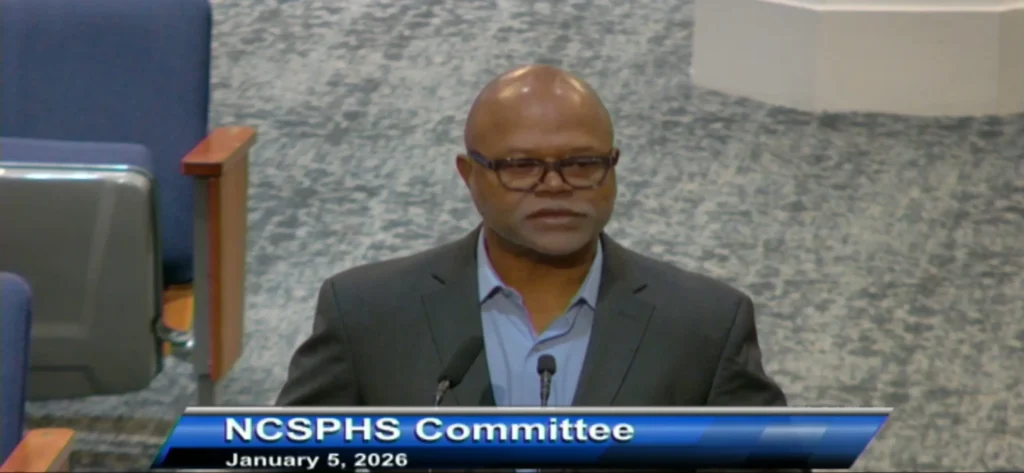
“We truly believe that within three years significant improvements will have been made to the building, allowing the value of the building to increase. So it’s to our benefit, and to the city’s benefit as well,” Patterson said. “But we don’t intend to sell the building in less than three years. And quite honestly, we don’t intend to sell the property for a considerable amount of time.”