

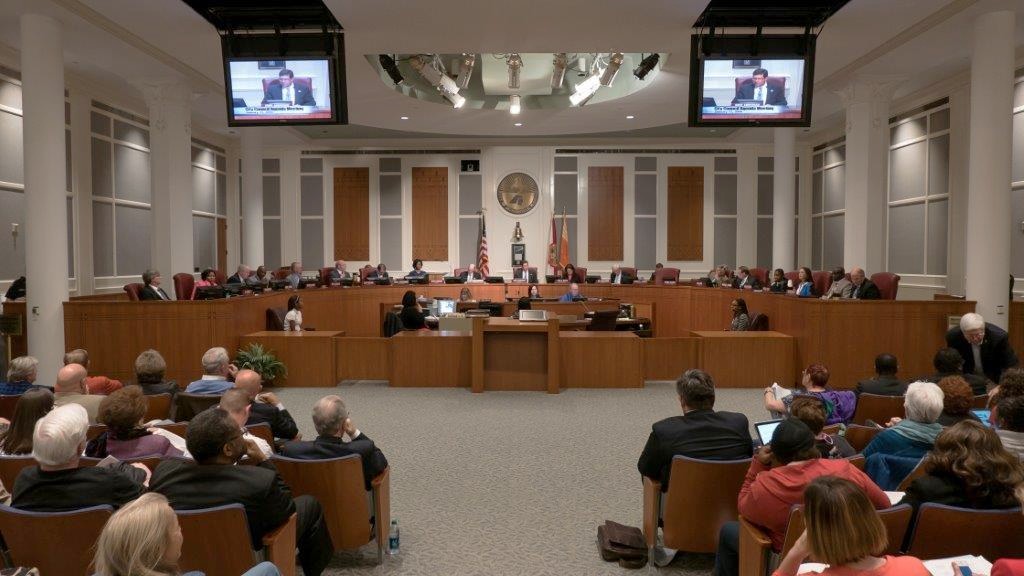
A Jacksonville City Council meeting. | City of Jacksonville
Published on December 22, 2025 at 5:38 pm
Free local news and info, in your inbox at 6 a.m. M-F. Sign up for the Jacksonville Today newsletter.
Here’s how to get involved in Jacksonville government, whether making your voice heard in Jacksonville City Council, joining a Citizens Planning Advisory Committee or volunteering with a political party.
Cast your ballot
First things first. You can’t choose your local government representatives without registering to vote or updating your voter registration. Voter registration can also be done in person at the Duval County Supervisor of Elections Office at any Duval County public library. You’ll need a driver’s license or Florida ID and your last four Social Security numbers to get started.
Jacksonville Today thanks our sponsors. Become one.
Although Florida is a closed-primary state, in Jacksonville, you can vote for any city council or mayor candidate regardless of whether your political affiliation matches theirs. City elections go to a runoff if no candidate gets a majority.
Want to connect with or volunteer for the Duval County chapter of a political party? Here are the Democrats, the Republicans and the Libertarians.
And just for fun: Here are the latest Duval County voter registration stats. As of this writing, Democrats held a slight registration edge over Republicans in Duval.



Jacksonville Today thanks our sponsors. Become one.
Get involved at City Hall
The Jacksonville City Council is the legislative body that enacts laws affecting all of Duval County. Council has 19 elected members: one from each of 14 districts and five who represent the county at large. (Four other independent governments in Duval County also make laws: Neptune, Atlantic and Jacksonville beaches and the town of Baldwin.)
The consolidated Jacksonville-Duval County government uses a strong-mayor form of government. That means the mayor has broad executive powers over city functions, including veto power over legislation. (More on that in a minute.)
How laws are passed
After a bill is drafted by the city attorney, a member or members introduce it at a City Council meeting for a first reading. Then it’s assigned to committee(s).
On a bill’s second reading, a public hearing is held, allowing citizens to speak for or against it. Committees may debate and amend the bill, then vote to recommend that the full council approve or deny it.
The bill is read a third and final time in the full council, and if the majority of members approve, the bill is sent to the mayor. It becomes law if the mayor signs it or chooses to let it become law without a signature (usually a form of protest). Similar to our federal legislative process, if the mayor vetoes the law, it returns to City Council, where it can be overridden by a two-thirds vote or a simple majority, depending on the type of bill.
Use your voice
There are several ways to make your opinion about proposed legislation known before City Council and the mayor act on it.
Speak up during committee hearings, held the first and third weeks of every month, or contact your district and at-large council members directly to share your thoughts.
Or, during regular council meetings, generally held at 5 p.m. on the second and fourth Tuesdays of each month, you may speak for three minutes during a bill’s public hearing. There’s also a 90-minute public comment period at the beginning of each meeting, when you may speak for three minutes on any topic. Before the meeting begins, you’ll need to fill out a speaker’s card.
Can’t attend a council meeting in person? Watch it live on the city of Jacksonville’s website, or on JAX+, the city’s 24-hour public information channel, Comcast Cable channel 99. Council meetings are also streamed on the JAX+ YouTube channel, Apple TV, Fire TV and Roku.
Citizens Planning Advisory Committees
Want to level up your involvement? Join your local Citizens Planning Advisory Committee, a city program meant to foster open communication between residents, community stakeholders and city government.
Jacksonville’s 200+ neighborhoods are divided into six planning districts, each with its own CPAC. CPACs are comprised of voting members who are nominated by community organizations like HOAs, PTAs or business groups.
The six committees’ monthly meetings, coordinated by the Neighborhood Services Office, are open to all residents. They provide a forum to ask questions, identify issues affecting your neighborhood — anything from land use to public safety — and propose solutions.
After community input on an issue, CPAC voting members make recommendations — like whether to support a rezoning application— and share them with government officials.
Other advisory boards and commissions
Beyond CPACs, Jacksonville has more than 60 volunteer boards and commissions to help the city run. Board members are appointed by the mayor or the city council, with some requiring council’s approval.
The majority are independent boards and commissions who advise the mayor and council on a wide range of issues, from homelessness and housing to planning and policing.
There are also community redevelopment boards, oversight boards and regulatory boards.
And Duval County also has nine independent authorities and agencies that are governed by their own boards, including the Jacksonville Aviation Authority (JAA), JEA (formerly the Jacksonville Electric Authority); JAXPORT; and the Jacksonville Transportation Authority (JTA). The public may attend many of their board meetings in person or virtually and speak during public hearings. If you attend virtually, you may submit questions in advance.
Page program
You don’t have to wait until you’re of voting age to get involved. Youth age 11-18 can get hands-on experience in lawmaking (and earn community service hours) by participating in the Jacksonville City Council Page Program. During the one-time commitment of two to four hours, the page assists with tasks that help the legislative process run smoothly during a City Council or Land Use & Zoning Committee meeting.