
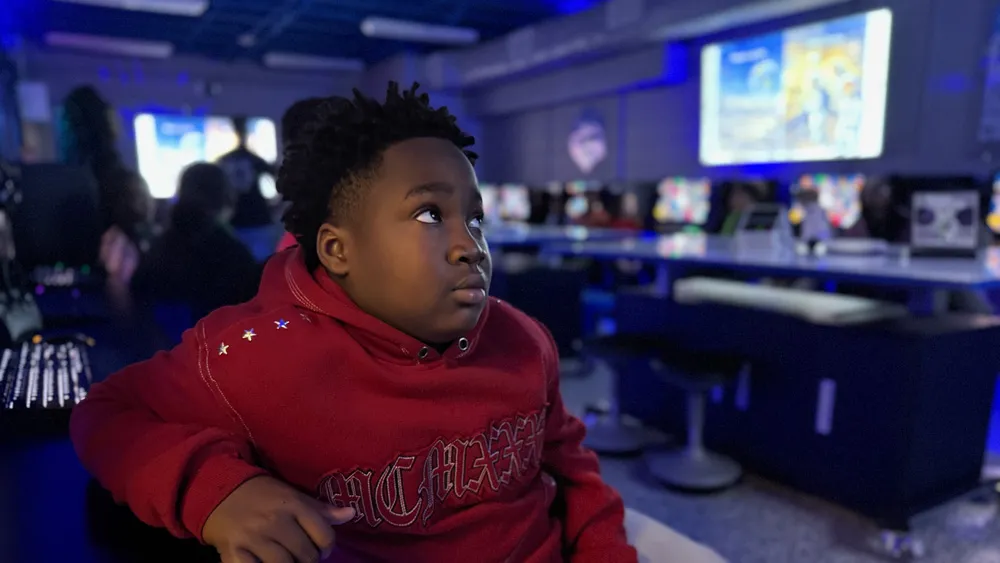
A student from Fort Caroline Elementary sits in the district's new 3D printing lab on Wednesday, Dec. 17, 2025. | Megan Mallicoat, Jacksonville Today
Published on December 18, 2025 at 5:45 pm
Free local news and info, in your inbox at 6 a.m. M-F. Sign up for the Jacksonville Today newsletter.
Students from Fort Caroline Elementary took a field trip Wednesday — and got to be the first to try out Duval Schools’ new 3D printing lab.
The lab is the newest addition to the district’s STEM Innovation Center. Science, Technology, Engineering and Math instruction has become a big part of K-12 education in recent years, and like many districts across the U.S., Duval Schools has looked for ways to give students the hands-on experiences that are a hallmark of STEM instruction.
Jacksonville Today thanks our sponsors. Become one.
Nicknamed “The STEM Forge,” the new lab features a wall of 16 3D printers and 20 gaming-caliber computer workstations. A federal grant funded most of it, and local companies like JEA, Chhem Coatings and Arete Construction donated equipment and services to finish the project.
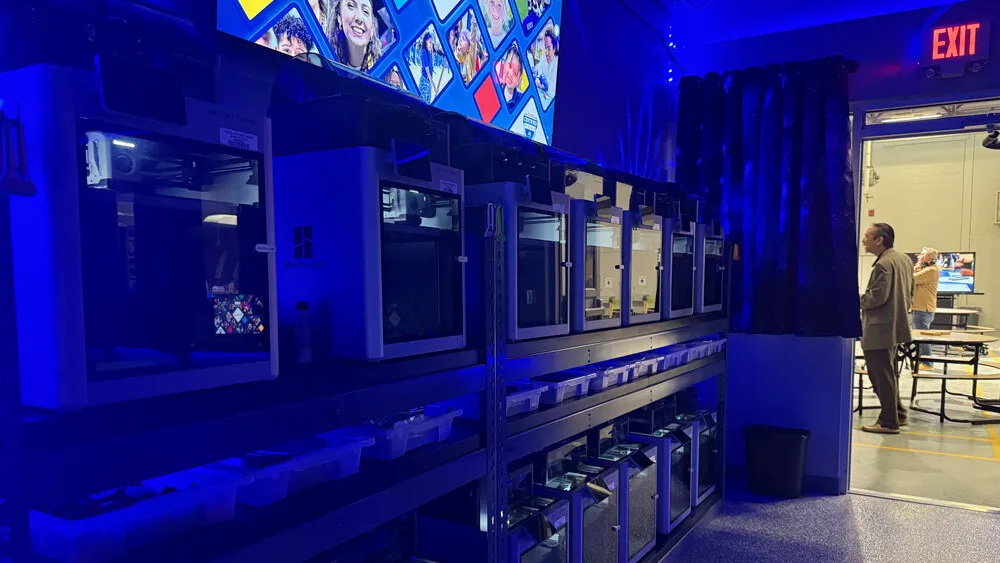
The STEM Innovation Center is a “state-of-the-art learning space designed to expand hands-on STEM opportunities for students across our district,” according to a Duval Schools statement. It’s designed to host field trips and give kids a chance to try out cutting-edge technology while also learning “science-aligned” lessons.
“We’re trying to create entry points and interest for students to have those future careers,” said Duval Schools Director of Science Yvonne Day.


Jacksonville Today thanks our sponsors. Become one.
Staff create lessons that support concepts students learn about in their classrooms.
In the Minecraft Lab on Wednesday, for example, half of the 50 Fort Caroline fifth graders navigated a game while also learning about phases of the moon — something that will help them this spring during state testing.
“They’re coming here on a field trip, and we’re sneaky deaky teaching them about moon phases so they do better on their fifth grade science assessment,” Day said.
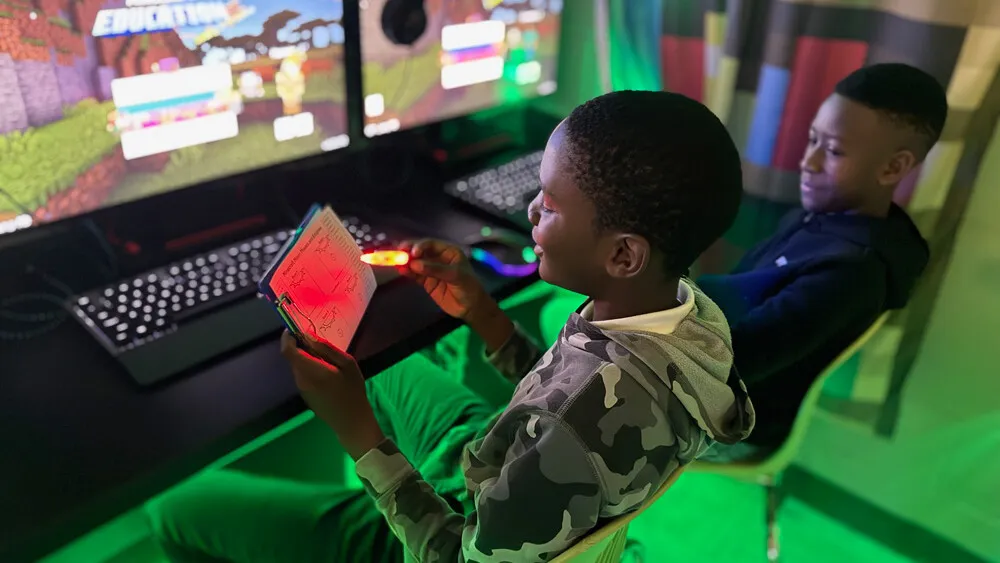
The other half learned about prototyping and design in the 3D printing lab, then designed and printed their creations to take home. Printing can be a slow process, but the lab was ready to help students design projects that could be finished before the students left.
“They’ll work to design their builds,” Day said. “As long as the builds are small, they’ll be able to get in and out of here with their builds.”
After lunch, the groups would switch so that all of the students got to do both of the activities their teachers selected — 3D printing and Minecraft.
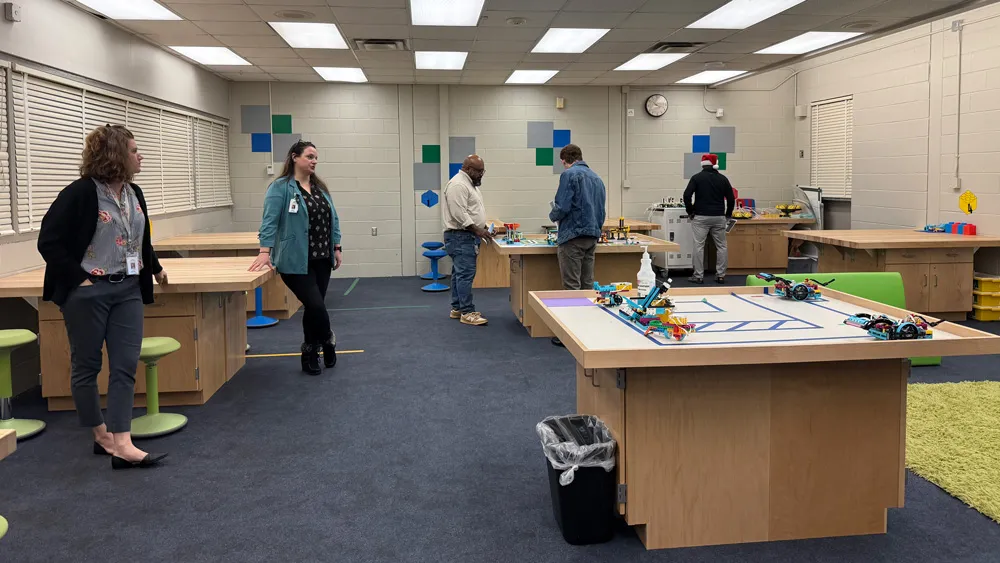
In the center’s Lego lab, students learn entry-level programming skills to build and control Lego robots. Day says they also often host practice events for the district’s numerous robotics teams to prepare for competitions.
Funding for 3D printing
The center has won multiple federal grants in recent years. One funded a mobile lab — a trailer stocked with computer workstations that will take the center’s resources on the road to schools around the district. An award from the Department of Defense’s educational programs office built the new 3D printing lab.
Housed in space at A. Philip Randolph Career Academies, the center serves teachers too. It offers continuing education programs, and there’s a library of tech tools teachers can borrow for their classes. If a class visits the center and uses the Lego robotics lab, for example, there are Lego sets the teacher can check out.
“Nothing takes place that we can’t replicate in the school because we want that continuity,” Day said. “We don’t want them to have a one-and-done experience.”
Some schools have STEM resources on site, but it’s expensive to outfit every school in the district with these kinds of tools. Day said that if they see a teacher using the library’s resources especially well, they try to help get a set just for that school so they don’t have to share.
Taking up space
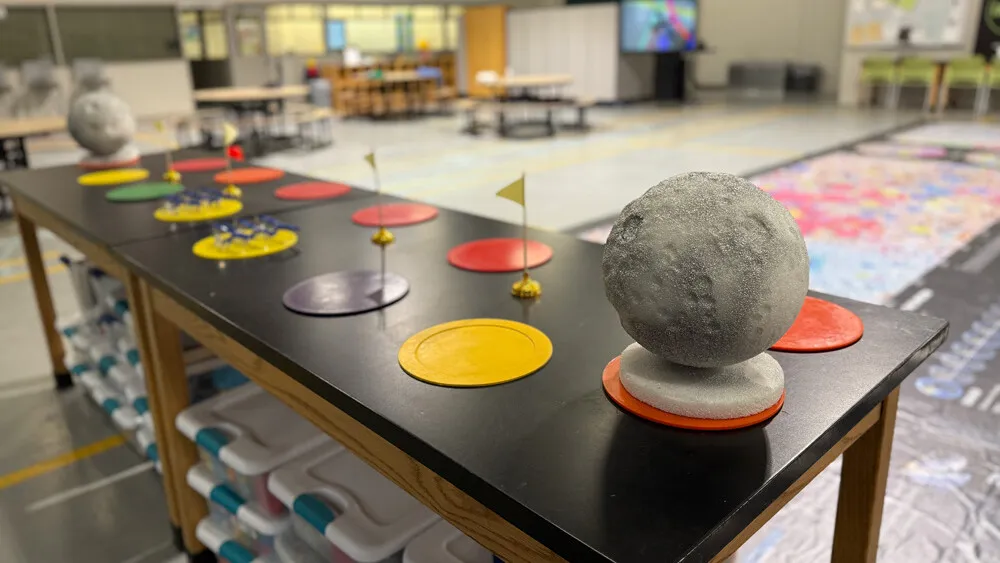
The STEM Center is decorated with space memorabilia.
There’s a copy of The Florida Times-Union’s edition from July 21, 1969 — the day after Neil Armstrong and Buzz Aldrin landed on the moon — on display where the teachers come for their continuing ed. A “Giant Moon Map” — a gift from the Aldrin Family Foundation — covers the floor of a commons area where students eat lunch during field trips.
Space might be a problem, though.
A. Philip Randolph is one of the schools on Mater Academy’s list for Schools of Hope. Mater says it wants to open a school that would house 873 students within five years of opening.
The space A. Philip Randolph gives to the center isn’t traditional classroom space. The school has space for 1,179 students but just 358 enrolled right now, but the district is using the building for educational activities. It’s unclear how that might affect its vulnerability to a School of Hope.
The district didn’t respond to a request for clarification before this article’s publication.