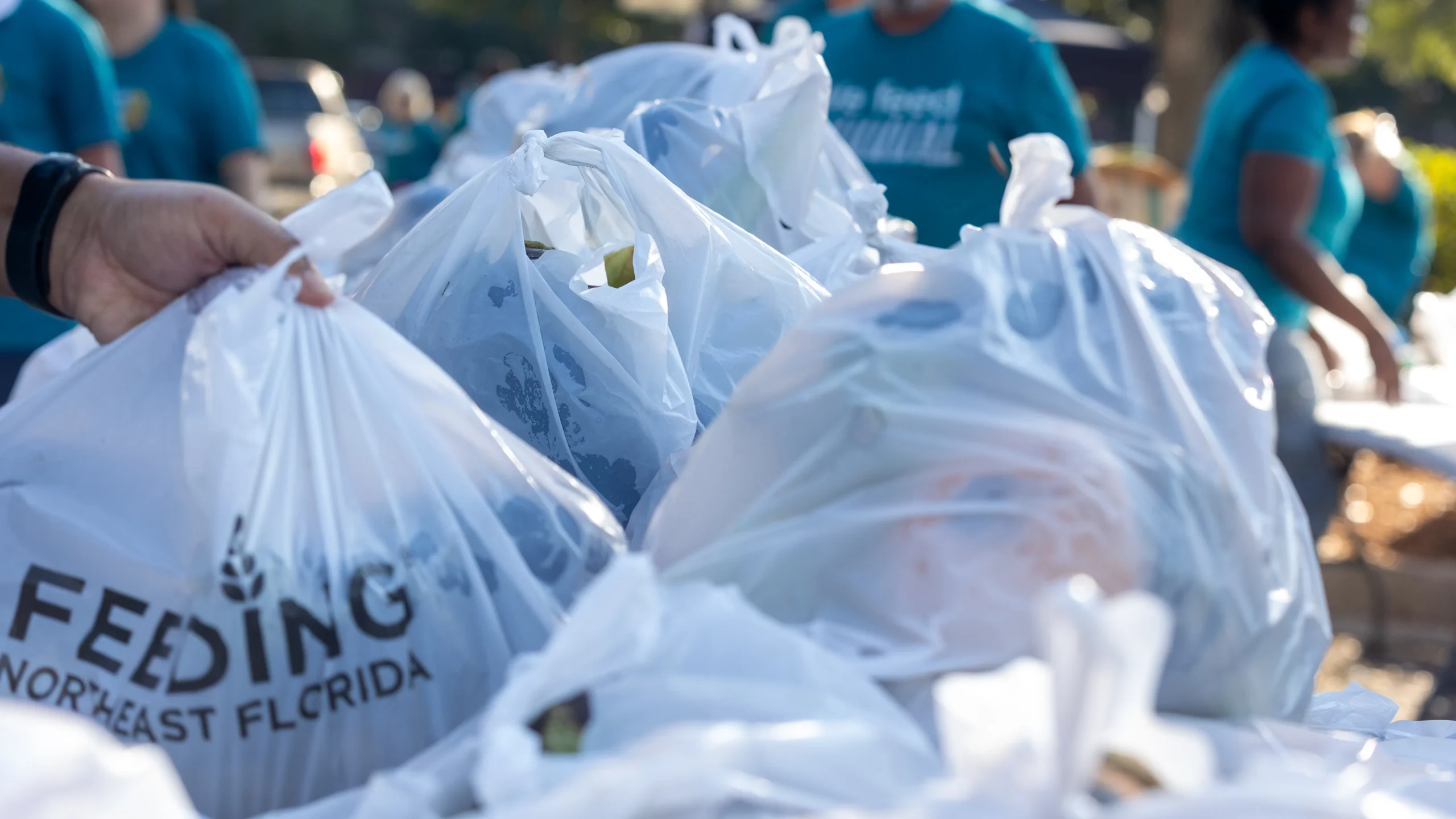
Feeding Northeast Florida received a $250,000 donation from Baptist Health to combat food insecurity in the region. The food distribution nonprofit says the money will fund 215,000 meals. | Will Brown, Jacksonville Today
Published on December 8, 2025 at 4:32 pm
Free local news and info, in your inbox at 6 a.m. M-F. Sign up for the Jacksonville Today newsletter.
When Baptist Health identified food access as part of its core commitment to improving health outcomes in Northeast Florida earlier this year, it could not have envisioned the scope of the problem it would soon become.
This month, Baptist Health announced it will donate $250,000 to Feeding Northeast Florida. The money will provide an estimated 215,000 meals.
Jacksonville Today thanks our sponsors. Become one.
Baptist’s donation to the region’s largest food bank and distributor follows the donation earlier this fall of a refrigerated truck to Waste Not Want Not, a nonprofit based in Orange Park.
Katie Ensign, Baptist’s vice president of community impact, says the lack of access to fresh food or a lack of nutrition were things respondents noted as Baptist compiled data for its 2025 Community Health Needs Assessment.
“All six of our hospitals chose to try to address food insecurity over the next three year,” Ensign says of the health system that operates in Baker, Clay, Nassau and St. Johns counties.
Jacksonville Today thanks our sponsors. Become one.
“We have already been trying to invest in food pantries to address food insecurity. As Feeding Northeast Florida is the largest distributor of food in the region — that serves all five of our counties — we thought this is a really important time to ensure food can get to that local level to the 400 agencies that they support.”
Feeding Northeast Florida officials have maintained for years there is additional demand for food assistance during the holiday months.
The need has been greater that usual this year.
When the federal government failed to fund its operations for six weeks in October and November, it led to delayed paychecks as well as the expiration of federal Supplemental Nutrition Assistance Program funding.
Nearly 300,000 people in Feeding Northeast Florida’s 12-county service area use the SNAP program. There are tens of thousands of others who do not receive government assistance but access sustenance through food distribution.
“It can be a cascade of events that occur that really put so much pressure on a system that was already under a lot of pressure,” Ensign says. “The needs were growing. … The longer the shutdown went on, and the more vulnerable people were becoming, we really wanted to make sure (we provided where we could).”
Addressing food insecurity
In its Community Health Implementation Plan, Baptist identified increasing the capacity of local organizations to provide healthy food as well as collaboration with community organizations to provide cooking demonstrations and nutritional information as ways it could reduce regional food insecurity.
When the Health Planning Council of Northeast Florida produced its Duval County health profile this year, it found Duval is “more likely to experience negative outcomes during emergencies, disasters or disease outbreaks” than other counties in Florida.
The region’s nonprofit hospital systems, which include Baptist, are members of the Health Planning Council.
Individual health systems produced their Community Health Needs Assessment. When Baptist completed its assessment in June, it identified improving access to transportation and access to healthy food as focuses over the next two years. The plan went into effect Oct. 1, the first day of the longest federal government shutdown in American history.
Waste Not Want Not Executive Director Kathleen Spears says the organization has discussed food insecurity with Baptist Health for more than a year.
From visits to headquarters in April, to conversations about the impact of a food truck, Spears says Baptist has provided a financial seed that will bear enough fruit to feed thousands.
“Our partnership with Baptist goes beyond a contribution,” Spears says. “They volunteer. We were able to leverage their gift to secure the largest monetary gift in our 35-year history to expand our facility. Their students collect food for us. It’s a beautiful partnership. I’ve been in fundraising for 15 years, and I’ve never had an experience where a corporation cares so deeply.”
Waste Not Want Not obtains food from nearly three dozen locations across 14 counties and distributes it to people who need it. It secures an estimated 2 million pounds of food annually.
The nonprofit won a grant from Baptist in November. Spears says the refrigerated truck will be in service by January.
The expiration of SNAP benefits illuminated how many people either receive food assistance or face challenges in securing food.
Feeding Northeast Florida CEO Susan King says the connection and partnerships have allowed Feeding Northeast Florida to stagger, but not succumb, to the financial pressures caused by SNAP reductions and a rise in food insecurity.
King previously told Jacksonville Today that the region’s nonprofit and philanthropic community stepped forward to bridge some of the chasm caused by shifts in federal policy.
“We don’t do anything that doesn’t involve volunteers, corporate partners and foundational support,” King told Jacksonville Today during a food distribution held Nov. 24 alongside the Jaguars Foundation. “I mean, it is a village. It takes all of us. It takes the 400 agencies that distribute food that are the boots on the ground for our organization.
“We could not do it alone. We are a logistics, warehouse, distribution business at our core. So, when we can come alongside organizations that provide resources and volunteers, our work is exponentially impacted.”