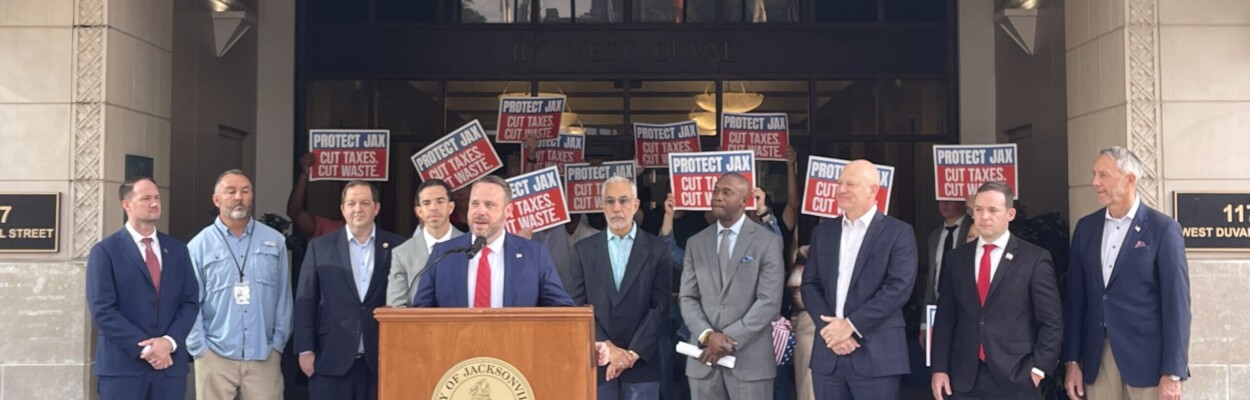
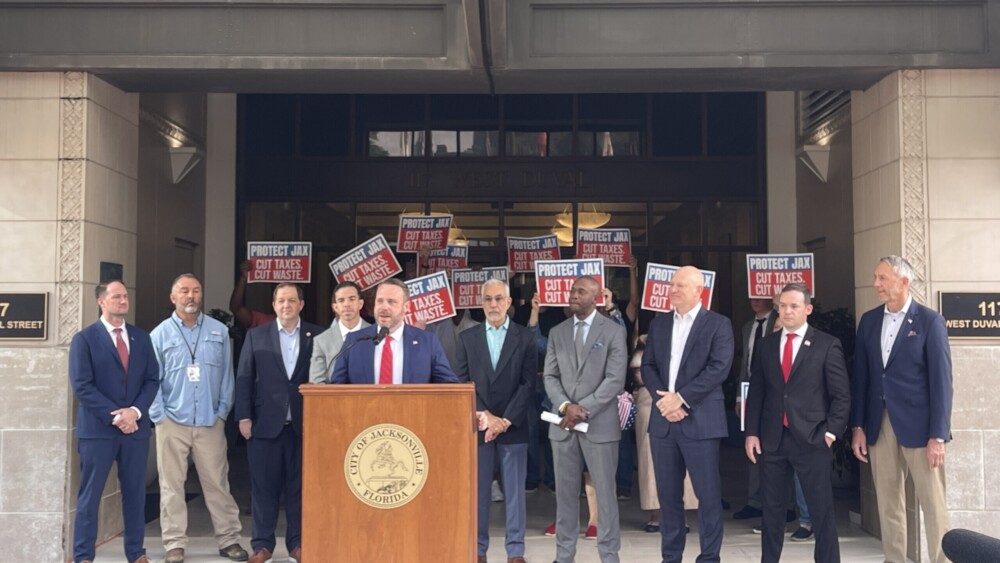
Jacksonville City Council President Kevin Carrico speaks about the city budget and proposed property tax cut on Aug. 25, 2025 at City Hall. | Mike Mendenhall, Jacksonville Today
Published on December 7, 2025 at 4:27 pm
Jacksonville Today seeks to include a diverse set of perspectives that add context or unique insight to the news of the day. Regular opinion columnists are independent contractors who are not involved in news decisions. Want to submit your own column on a matter of public interest? Email pitches to jessica@jaxtoday.org.
One would think that a GOP supermajority on the Jacksonville City Council would mean a united front among Republicans.
One would be wrong.
Consider the legislation (Bill 2025-869) from Matt Carlucci that seems like a not-so-veiled critique of this year’s installation for Council President Kevin Carrico, which was held in a private facility far away from City Hall and funded, as these events always are, by stakeholders in the community – unions, lobbyists, etc.
Jacksonville Today thanks our sponsors. Become one.
Carlucci’s measure holds that “hosting the installation of Council officers or related events in a publicly-owned or operated facility reduces the appearance of exclusivity and ensures maximum opportunity for public access.”
It would require the council secretary to maintain “a list of public facilities owned or operated by the City, its independent agencies and constitutional officers, which provide an appropriate event space to host the installation or related events.”
And the only exception from this would be with supermajority approval of the City Council itself.

Jacksonville Today thanks our sponsors. Become one.
A “request to waive this Section shall be accompanied by a justification which shall, at a minimum, indicate why a public facility owned or operated by the City or one of its independent agencies or constitutional officers is not sufficient or available to host the installation or related event.”
Some wonder why this only applies to City Council, of course.
When Mayor Deegan was sworn in, ticketed events surrounded the moment.
These included the “Mayor’s Inaugural Prayer Breakfast” at the Garden Club in Riverside, and the ticketed “Mayor’s Inaugural Ball” event at the River Club.
As someone from a working class background whose only entries into the River Club came when I was considered relevant enough to talk into a microphone for an hour or so, I can tell you it’s a bit fancier and more exclusive than the Lynwood Roberts Room.
Many of the same people funding Deegan’s events in 2023 put money into Carrico’s in 2025 also. No matter how many square miles are on the map, this is a small town in the end.
Perhaps one can argue that a City Council President doesn’t deserve the latitude a mayor gets, but that argument boils down to either a belief that mayors are sui generis in their ability to have political events, or in personal political preference.
The mayor’s office declined to comment on this bill, but the question stands: Would Matt Carlucci’s argument be more compelling if it applied to all elected officials?
Kevin Carrico’s response
For his part, Carlucci says he “began this ordinance by addressing City Council installations because that’s the body I serve on and the situation that put the issue on my radar screen.”
He’s willing to expand the scope.
“If my colleagues believe it should also cover other city inaugurations or installations, including the mayor or other elected officials, I would certainly welcome that and have no objections.”
Who knows if the proposal gets that far though.
For the council president, Carlucci’s bill is personal.
Carrico says it represents a grab for relevance from a political rival closer to the end of his career than the beginning.
“While we’re delivering real results for Jacksonville — from historic public safety investments to long-overdue property tax cuts — Mr. Carlucci is focused on a performative bill that doesn’t help a single resident. It’s exactly the kind of out-of-touch legislation you’d expect from someone whose time as council president ended a quarter century ago,” he told me last week.
The tension between Carlucci and Carrico preceded his installation. Recall that when Carlucci left a meeting this spring, Carrico reportedly felt “threatened” by his colleague’s demeanor.
But Matt isn’t the only Carlucci on the Council. Joe Carlucci just became Finance Chair after Raul Arias stepped down from the most meaningful perch on the council, as reporting showed his family business Mambo’s Cafe received contracts from the ceremony.
Matt Carlucci says he won’t speculate on what drove Arias to resign, but he expects his son to be a great chair.
Meanwhile, Joe Carlucci did not respond to a request for comment when asked, saying he hadn’t looked at Matt Carlucci’s bill.
Even if the bill somehow got traction from the council that overwhelmingly elected Carrico to lead it, there are questions as to whether state law supersedes it.
Florida Statute 111.012 seems to allow for the mechanism that facilitated the Carrico installation. It allows for fundraising without caps and is agnostic on where so-called “testimonial” events are held.
This raises the question of why the Jacksonville City Council merits a singular higher standard.
Ultimately, Carlucci likely has little recourse when it comes to reining in installations.
In part because the suggested remedy is so localized.
In part because there is so much precedent allowing a wide berth for these events.
And also in part, because most everyone on the council envisions long careers in politics, and can imagine a circumstance where they too might want to throw a private party under the right conditions.